
"Christ Crucified For You"
This service is always a powerful confrontation… the part of the Gospel story that’s the hardest to deal with. The cross. But it’s the most important part of the story to keep in our mind.
Because there’s always something waiting around every corner to knock us down. Always something in the shadows ready to pounce on our faith and try to drag it down into the pit where we’re tempted to doubt that we can trust God. Why would He let terrible things happen to us? We wonder if He’s really there or if He’s punishing us. Those are dark places.
Especially if we only think about Jesus in more happy “What’s in it for me” ways…
Because in the modern church, we tend to think of Jesus as our life coach... Giving us tips for productivity, He’s our therapist who wants us to know we’re okay just as we are, to “feel seen,” He’s our political mascot who happens to agree with us on everything, He’s a vibe, a brand, a bumper sticker that says “#blessed.” Like a self-help app.
And sure, Jesus does teach. He is wise. He does comfort us. But none of those ideas get to the center of how Jesus has truly revealed Himself to us. Without looking at the cross, we end up with a version of Jesus who inspires us a little, makes us feel a little better, but doesn’t really have what it takes to save us—because a Jesus who doesn’t suffer, and bleed, and die can’t actually deal with sin, or death, or all the darkness we face in the real world.
What do we think of when we think of God?
A powerful bearded old man on a majestic throne? A booming voice from the clouds? Maybe a long haired, glowing Jesus doing miracles, walking on water, raising the dead—or seated in glory at the right hand of the Father.
And none of that is wrong. But it’s not the center of how Jesus revealed the love of God to us. It’s not the way He wants us to think of Him. The clearest, fullest, most helpful revelation of who God is… It’s not on a throne—it’s on a cross. When we think of God, the first thing He wants us to think of is Christ crucified.
In 1st Corinthians 1:23, Paul said,
“We preach Christ crucified.” 1st Corinthians 1:23
Not Christ inspiring, not Christ coaching, not Christ fixing our life… Christ crucified. Because that’s where God has made Himself known.
Now, I know for some of you, this is a little uncomfortable. Because people see a crucifix and they say, “Yeah, but Jesus isn’t on the cross anymore.” And that’s true. He’s not.
But when we focus on the cross, we’re not saying Jesus is still there suffering—we’re saying this is where He chose to reveal Himself the most clearly. This is how He wants us to remember Him.
The image of Jesus on the cross is very disturbing. No doubt about that. We don’t do all this to cause nightmares. The point is to really understand what Christ has done for us.
The cross is where He chose to make Himself known most clearly, to give us some perspective as we live this life of faith following Jesus through all these dark valleys and shadows of death.
All this might sound strange if we’ve spent most of our time in well meaning modern churches that teach it’s always God’s will to bless us… financially… to heal us in this life, And if we don’t receive those spiritual breakthroughs it’s probably because we don’t have enough faith, or we’re not thinking positive enough, not manifesting God’s blessing in our lives, not worshiping with enough joy and enthusiasm.
There’s a lot of subtle misunderstanding in the modern church about what the New Testament actually teaches—the teachings of Jesus that He gave to the apostles and has been passed down to us.
It’s the difference between having a theology of the cross… and a theology of superficial glory.
I mean, glory sounds great, but we don’t get to know God by looking at power, or success, or personal accomplishment. We get to know God the way He wants us to know Him, when we look at Jesus, the image of the invisible God, and we understand everything through His suffering and the cross.
But, of course, that goes against everything we know in this world.. The world tells us to look for God in strength and power. Look for a God who wins, a God who dominates, a God who looks impressive. Gives us everything we want, now. Instant gratification.
We want resurrection without Good Friday. We want the crown without the cross. But God says if we want to know Him, we have to look here—at the tortured, bleeding, dying Son of God, at Jesus mocked and abandoned, at the Son of Man who doesn’t come down from the cross, who doesn’t call an army of angels to save Him, even though He could, even though He’s experiencing the full weight of sin, shame and abandonment. You want to know God? Look at the cross, that’s where you’ll find Him.
It’s weird… the cross. The device of torture and execution. We wear it as jewelry, hang it on our wall, and put it in our church logo, but… what it means for our life… We don’t like it. We don’t really want a cross-shaped life. We don’t want weakness, or suffering, or things beyond our control. The cross is definitely a reminder that we don’t really control anything. Life is eventually going to break us and we won’t be able to fix ourselves. Life is a one way ticket to death. No exceptions.
We try to stay healthy. Try to live right. Doesn’t matter. We all have an appointment to stand before God.
So, people are like, “Okay, I got it!” I’ll be better, I’ll try harder, I’ll clean myself up—I’m going to be the kind of person God wants me to be, the kind He will accept. But the cross stands there right in front of us and says, “You can’t—not even a little bit, not mostly, not eventually. You can’t do anything to make up with God… you can’t save yourself.” Because if you could, this whole Jesus on the cross thing would not be necessary.”
This whole service is to give us the right perspective. The only thing we can do is look up to Jesus, who was on the cross in our place, and say, “Lord, You are my righteousness, and I am Your sin.” That’s the message of Good Friday. That’s what’s happening. It’s an exchange. Here’s what you bring—your sin, your guilt, your shame, your failure, your hidden thoughts, your worst moments—and all of it’s put on Him. And then everything He brought to the cross—His righteousness, His perfection, His obedience, His good standing with the Father—He gives all that to you. Doesn’t really seem like a great deal from His perspective, does it? But He gives it to you as a life saving gift. Free. And it was His idea. He wanted to do it for you.
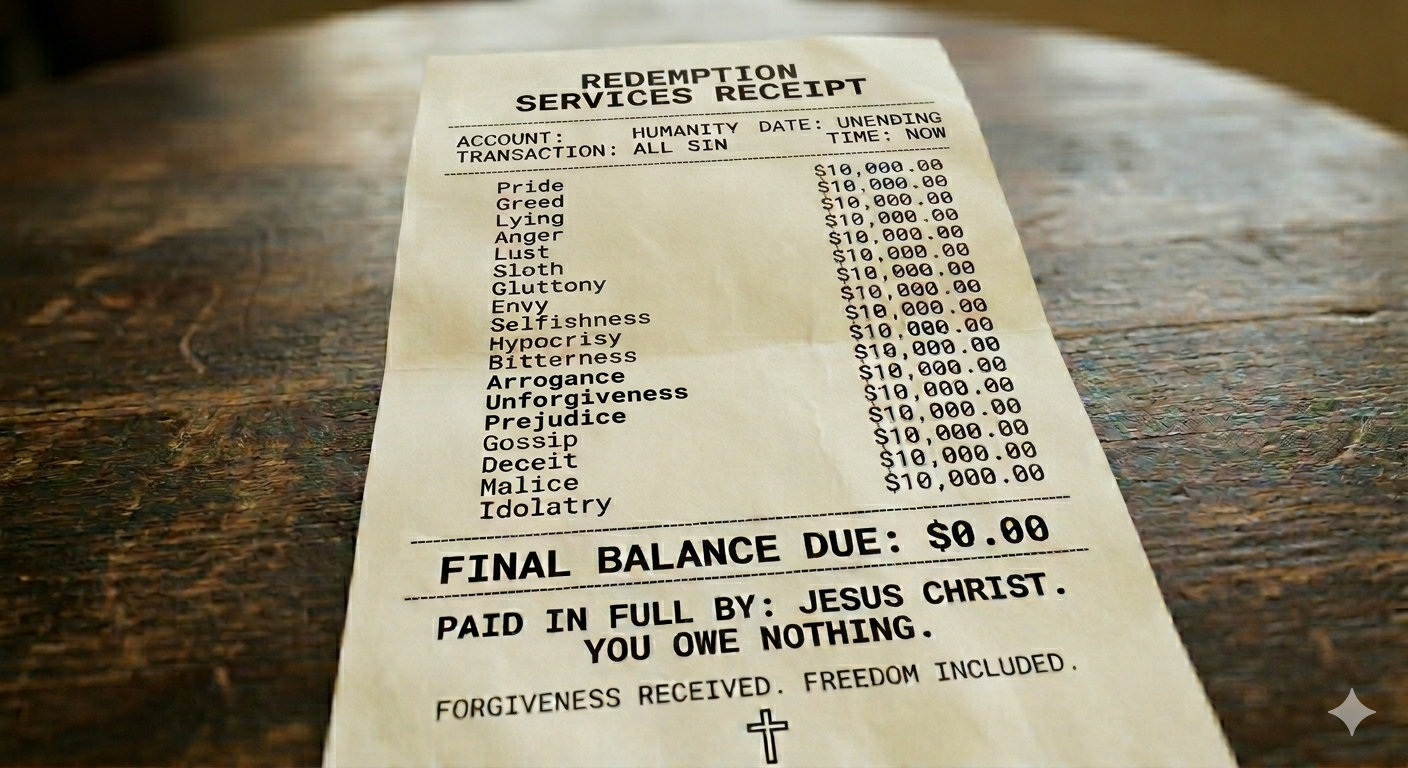
And it’s the only sacrifice that ever really did anything. Everything that came before—the temple, the priests, the sacrifices of bulls and sheep and all that—they were all just a shadow, pointing to this moment. This is the one that counted. Those were all IOUs, checks waiting for a deposit before they could be cashed, credit charges. The cross of Jesus is the once-for-all sacrifice that never needs to be repeated. He paid every debt—past, present, and future.
And then keep the cross in front of you as you live this new life He’s given you. We need the perspective of the cross, because life is still going to be painful. Things are going to break, plans are going to fall apart, people are going to disappoint us—even our own hearts are going to betray us. And we’re going to be tempted to think God must have forsaken us, that He must not be real, or He doesn’t care. But when we keep the cross at the center of how we think about God, then it all looks different—because it reminds us that God does His most important work, not in strength, but in weakness… not in glory, but in suffering. The cross reminds us that God doesn’t avoid suffering—that’s where He’s revealed.
And it doesn’t only show us who God is, the cross also shows us who we’re supposed to be.
It shapes how we live. Jesus says, “Take up your cross and follow Me,” and that doesn’t mean going out and looking for suffering or trying to prove something to God. It means when suffering finds us, we know God will meet us there.
It means your life will take on the same shape as His. It looks like laying down your life for others, loving people who don’t deserve it, and forgiving them when it actually costs you something. It shows up in the way you treat your spouse—with patience and sacrifice instead of keeping score, loving them with honor and respect and kindness—it shows up in the way you love your children, not being annoyed, not just when it’s easy, but when it’s exhausting and inconvenient. It even means loving your enemies, remember Jesus’ prayer for the men who were crucifying Him? “Forgive them, they know not what they are doing!” It certainly doesn’t mean you have to approve of everything they do—it means you refuse to return evil for evil. The cross doesn’t just save your life—it shapes how you live it.
And yes, if Good Friday wasn’t followed up with Easter, if the cross didn’t lead to the resurrection, then none of this would matter. If God hadn’t promised that in the same way Jesus was resurrected, you will also be raised from the dead… in your body… when He returns… then none of this would mean anything. But Christ was raised. He is risen and it’s all true.
I know this Good Friday service of Shadows can be a lot. My hope is you’ll carry this image of the cross with you into your doubts, into your suffering, and into your everyday, messy life. Remember our hope is not in a distant God, not an abstract idea, but Jesus Christ crucified for you. Which means your sin is forgiven, your standing with God is certain, the world, the flesh, and the devil have been defeated, and your future is secure. Amen.