
"When God Feels Gone"
Some words we use so much we don’t really think about what they mean. Like the word “pants.” Pants is a weird word. Why is it a pair of pants? Pants are clearly one thing. Are they confused? Their pronoun is even “they,” which makes it worse. They’re not like shoes or socks or gloves, where a pair actually means two separate things. That makes sense. But pants? Clearly one thing. Yes, they have two legs, but if I told you I bought a pair of shirts, you’d expect me to mean two shirts wouldn’t you… even though a shirt is made for two arms.
Other words are weird, too. Like “Awesome.” “Awesome” used to mean something that actually filled us with awe. Now it could mean how we feel about a new chicken sandwich. Or, “Legendary”... used to be saved for something unforgettable. Now we could be talking about how someone looks in a new outfit.
I think “Easter” is one of those words… we forget how strange it really is. So, buckle up. Put on your Easter pants! Ha
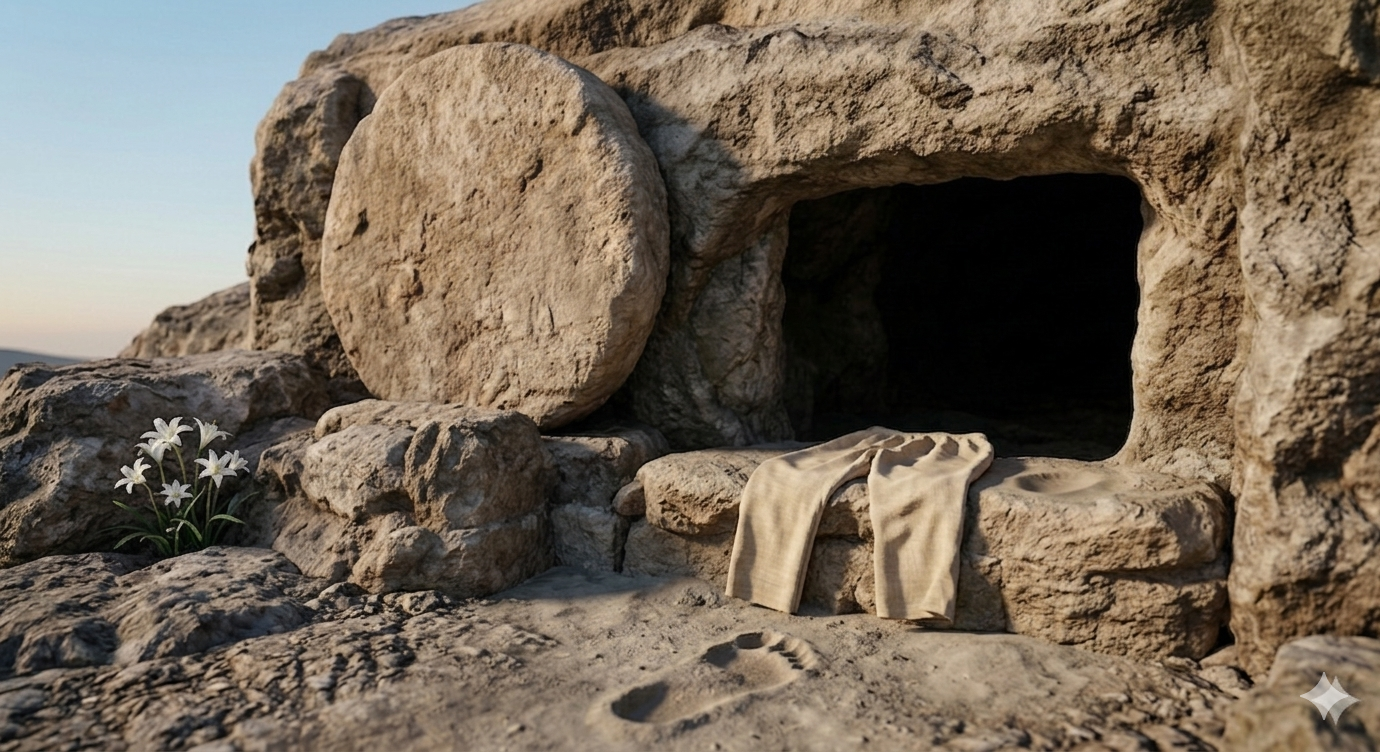
Because we think of Springtime and colorful eggs and chocolate bunnies. But Easter isn’t really about those things. It’s not even about going to church. Easter means Jesus is gone. Gone from the tomb. Gone from the place death put Him. And on the original Easter, it didn’t seem like good news at first. Jesus was gone and it felt like something had gone horribly wrong.
Kind of like how we experience life most of the time. God does something, and before we even consider it might be something good, we stress out. Something changes, and our first thought is almost never to assume God is doing something better. We don’t like change unless it’s our idea. And even when it’s something better, we don’t usually see it at first.
Our first reaction is anxiety. A job change, might even be a promotion, but we wonder if it’s going to be too much pressure, too much commitment, are we up for it? Move into a new season of life, maybe even something we’re looking forward to, but we feel sad about what we’re leaving behind. A relationship changes and we don’t know what to think about it. The check engine light comes on in our health and we worry about giving up old bad habits and the discomfort of new healthy ones—mourn the loss of junk food. Change is scary. Our first thought is almost never, “This must be God doing something good.”
Well, that’s exactly where the Easter story begins—with confusion and the assumption that something terrible has happened.
The Gospel of John 20:1–18 says this:
“Early on Sunday morning, while it was still dark, Mary Magdalene came to the tomb and found that the stone had been rolled away from the entrance. She ran and found Simon Peter and the other disciple, the one whom Jesus loved. She said, ‘They have taken the Lord’s body out of the tomb, and we don’t know where they have put him!’ …
(Then she went back to the cemetery) Mary was standing outside the tomb crying, and as she wept, she stooped and looked in. She saw two white-robed angels, one sitting at the head and the other at the foot of the place where the body of Jesus had been lying. ‘Dear woman, why are you crying?’ the angels asked her. ‘Because they have taken away my Lord,’ she replied, ‘and I don’t know where they have put him.’ She turned to leave and saw someone standing there. It was Jesus, but she didn’t recognize him.
‘Dear woman, why are you crying?’ Jesus asked her. ‘Who are you looking for?’ She thought he was the gardener. ‘Sir,’ she said, ‘if you have taken him away, tell me where you have put him, and I will go and get him.’ ‘Mary!’ Jesus said. She turned to him and cried out, ‘Rabboni!’ (which is Hebrew for “Teacher”).”
Mary Magdalene was one of Jesus’ close disciples. She was at the cross. She watched Jesus die, she watched Him get sealed in this tomb. That was Friday, Saturday had to be the most depressing day ever. What’s she going to do now? What does anything mean? Who even is she? The story picks up on Sunday before sunrise. She gets there early, it’s still dark. Everything feels dark. She thought her hope was dead inside that tomb, too. She shows up expecting to find His dead body. That’s how death works. It keeps what it takes.
But when she gets there, the stone has already been rolled away. She assumes something has gone wrong. She runs to the other disciples and tells them, “Someone has stolen the Lord’s body!” That‘s her interpretation of what she finds. There can be nothing good about Jesus being gone.
Even after she goes back to the cemetery, sees a couple of angels, and runs into Jesus Himself, she doesn’t get what’s happening. She’s still crying. She thinks He’s the gardener. This is interesting, because it shows that simply seeing Jesus isn’t enough. She’s standing right in front of the risen Christ, she even spoke to Him, but stays locked in her unbelief. She doesn’t believe until Jesus calls her. Until Jesus speaks her name. But when He does… everything changes. She sees Him for who He is, not because she figured it out, or made a decision, but because He revealed Himself to her by calling her name.
That’s still how Jesus makes Himself known. Through His Word. In other words, belief in the resurrection isn’t something we arrive at through careful observation or logical arguments. True belief happens when the word of Christ is heard and faith is created.
So it’s not just that we misunderstand Easter—that we’re blind to it because the world has wired us to expect something else. The problem is we fight it and resist what it actually means. We’re looking for something else. We don’t want to deal with sin and death. We don’t want resurrection if it means we have to die first. We just want Jesus to help us get our life together, not tell us that our condition is so serious that He had to die for it—we don’t want a Jesus who calls us to lay down our life, die to ourselves and pick up our cross.
So, we can have trouble understanding what Easter actually is. The resurrection isn’t particularly inspiring to people who think they’re doing fine on their own. If we don’t feel the weight of our sin, or the impending reality of death, or the limits of our own ability to fix ourselves—then Easter kind of seems unnecessary.
But for those of us who do feel that weight, Easter’s the greatest thing that ever happened. When we know we are guilty, when our sin isn’t just theoretical—I mean, oh sure we’re all sinners—but when we understand sin leads to death and death isn’t something we can avoid—then we get how much the resurrection really matters.
So, how can we get to a place where we understand that it matters?
How can we get beyond our blind spots, get beyond our misunderstandings to actually receive everything Easter has for us? It’s not going to be by trying harder to believe or forcing ourselves to see it differently. That just makes faith a mental exercise.
No, it’s going to happen for us the same way it did for Mary. When we hear Jesus speak to us. Faith comes by hearing the word of Christ. If she couldn’t believe by seeing the empty tomb, a couple of angels, and standing right in front of Jesus—then faith isn’t by seeing, it must come from somewhere else. It’s not something we can make happen, it has to come from outside us.
So we don’t look inside ourselves for faith, in our emotions or in our circumstances. Those things are all over the place. No, we have go to where Christ has promised to speak and be present. Where we can hear to His Word. Where we receive His forgiveness. We remember our Baptism. We come to His Table. It’s here, in His church, this is where the risen Christ is not distant or abstract. This is where He promises to be present and active.
Where the Gospel is declared.
Because where the Gospel declared is where faith is born. When His Word is spoken, something actually happens, something is actually given. Transmitted. It’s not just information about something that happened a long time ago. It’s the actual delivery, in time and space, of what Christ accomplished by His death and resurrection.
The Gospel
This is the first and most important idea of the Christian faith. That Jesus Christ, our Lord and our God, died for our sins and was raised again to make us right with Him. To forgive us and save us. His resurrection is the promise of our resurrection—Easter is proof that everything Jesus promised us can be trusted. Not just proof that He’s powerful, or that He’s who He says He is. It’s confirmation that His death actually accomplished what it was meant to accomplish. Easter is the proof that Good Friday was successful.
Sin has been dealt with. Death is defeated. The Father has accepted the Son’s sacrifice. Easter is the declaration that the work of salvation is complete and effective.
Easter is for those of us who feel the certainty of death, and the uncertainty of life. It’s for when we feel like Mary, when we find ourselves in the dark, not knowing what’s happening or where their hope has gone.
Jesus was gone but He’ll never be gone again.
Because He promises to never leave us or forsake us. He promises to be with His people to the end. He’s still alive—He continues to speak, to forgive, and to give life. To give us everything He accomplished on the cross and by His resurrection.
Maybe we hear those words so often we take them for granted. I hope not.
Because those words are what give us saving faith. Those words change everything.
We don’t like change. We resist it. Even when something better happens, it doesn’t usually seem like it at first. Change is scary. That’s Mary at the empty tomb. And that’s how we usually experience God doing things in our lives, too. We assume everything is bad, even when God is doing something better—and we just can’t see it, yet.
Pretty soon we’ll all be gone. Not gone for good, I just mean church will be over and we’ll go about the rest of our day.
Don’t leave today without really thinking about what Easter means to you. Don’t let it be like one of those words we don’t really think about—like awesome, or legendary. Easter is truly awesome. And legendary.
It’s the resurrection of the crucified One. The announcement that death could not keep Jesus, that our sin could not overpower His holiness, that our death will also not have the last word. That’s what we mean when we say “Easter.”
It’s the promise of hope. It’s the promise that darkness, and tears do not get the last word. Mary didn’t see anything good about Jesus being gone—not until the Lord called her name—then everything changed—He’s calling yours, too. I hope you can hear Him.
He is risen, and He is risen for you. AMEN
Prayer
Lord Jesus, we confess how quickly we assume something is wrong when things change, and how often we think You are gone when we don’t understand what You’re doing.
Speak to us as You spoke to Mary, calling us through Your Word, and give us faith to trust that what looks like loss is not the end when You are at work.
Remind us that You are risen, present, and for us, and strengthen us with Your forgiveness and Your promise of life. Amen.