
Acts 27 "When Your Plans Fall Apart"
I have this character flaw that sounds like a humble-brag. The flaw is I’ll stick with a plan long after the plan's gone sideways and turned out to be a terrible idea. I mean, what’s wrong with that? Persistence seems like a good thing, right? It usually is but you know the phrase "riding a dead horse"? I take that to another level. I don't just keep riding it. I'll ride it until it's dead, bloated, and sticking to the ground with maggots, but I’ll be like, "I think she still has some life in her." Doesn't matter that the situation's a complete disaster. I had a plan, and by golly, I'm going to see it through, even if it destroys everything in the process. I'll be the last one to notice that my brilliant idea's actually a sinking ship.
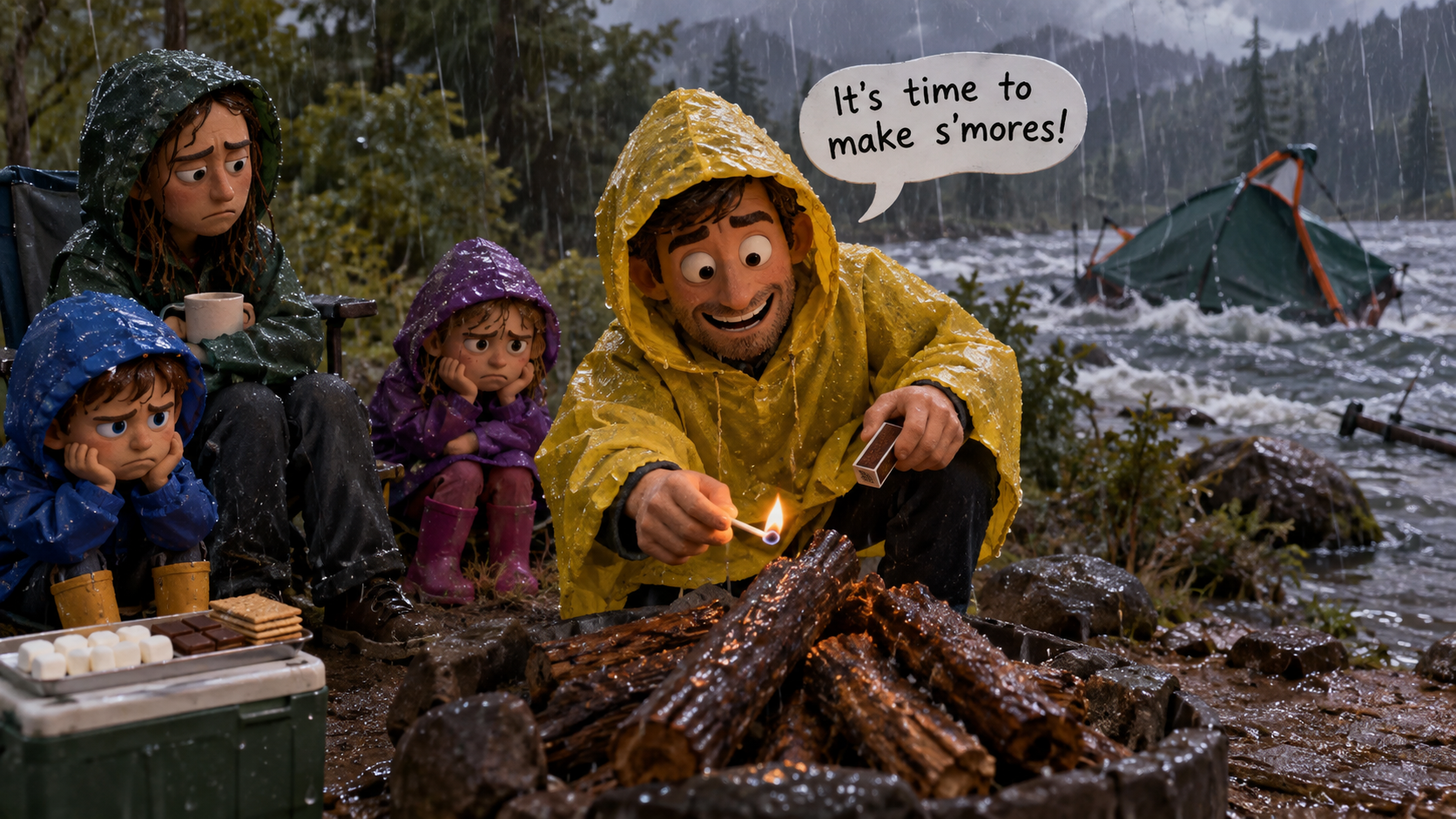
I think we all do it to some degree. Tie our emotional stability to a specific outcome, some vision of how we think things should be, and we refuse to let go when reality decides to violently disagree with us. Like maybe a family camping trip where it starts pouring rain, the tent’s leaking, the kids are miserable, but instead of going to a hotel, you’re out there in a poncho trying to light wet logs with a match because, "We're making s'mores! That’s the plan!" Nevermind the tent just got blown into the river. We took our kids camping once. Once. Ha.
Or, you know, we decide this job has to work out. This relationship has to be the one. The diagnosis has to be good, we don’t have time to be sick, it’s not part of the plan. Or at church, this program has to succeed, this vision has to happen. We dream our dreams, build our ships, map out our little voyages, and insist that if God loves us, He’ll make it happen, get us where we want to go, ensure smooth sailing. And when the storm hits. What then? Other than realize we’re completely out of our depth, and start hyperventilating because the thing we built our hope on starts to sink.
We’ve been going through the Book of Acts chapter by chapter—there’s only two left! Paul’s spent the last two years in jail for absolutely no good reason and today he’s finally on the way to Rome, like Jesus promised. What could possibly go wrong now?
Acts 27:1-44 says,
When the time came, we set sail for Italy. Paul and several other prisoners were placed in the custody of a Roman officer named Julius, a captain of the Imperial Regiment. Aristarchus, a Macedonian from Thessalonica, was also with us. (The 'we/us' language shows the author, Luke, personally experienced all this—Luke and Aristarchus are traveling with Paul. Keep that in mind as he describes the darkness, the terror, the desperate attempts to save the ship, and people crawling to the shore—this is something he personally survived.) We left on a ship whose home port was Adramyttium on the northwest coast of the province of Asia; it was scheduled to make several stops at ports along the coast of the province. The next day when we docked at Sidon, Julius was very kind to Paul and let him go ashore to visit with friends so they could provide for his needs.
Putting out to sea from there, we encountered strong headwinds that made it difficult to keep the ship on course, so we sailed north of Cyprus between the island and the mainland. Keeping to the open sea, we passed along the coast of Cilicia and Pamphylia, landing at Myra, in the province of Lycia. There the commanding officer found an Egyptian ship from Alexandria that was bound for Italy, and he put us on board.
We had several days of slow sailing, and after great difficulty we finally neared Cnidus. But the wind was against us, so we sailed across to Crete and along the sheltered coast of the island, past the cape of Salmone. We struggled along the coast with great difficulty and finally arrived at Fair Havens, near the town of Lasea.
We had lost a lot of time. The weather was becoming dangerous for sea travel because it was so late in the fall, and Paul spoke to the ship’s officers about it. “Men,” he said, “I believe there is trouble ahead if we go on—shipwreck, loss of cargo, and danger to our lives as well.”
But the officer in charge of the prisoners listened more to the ship’s captain and the owner than to Paul. And since Fair Havens was an exposed harbor—a poor place to spend the winter—most of the crew wanted to go on to Phoenix, farther up the coast of Crete, and spend the winter there. Phoenix was a good harbor with only a southwest and northwest exposure.
When a light wind began blowing from the south, the sailors thought they could make it. So they pulled up anchor and sailed close to the shore of Crete. But the weather changed abruptly, and a wind of typhoon strength (called a “northeaster”) burst across the island and blew us out to sea. The sailors couldn’t turn the ship into the wind, so they gave up and let it run before the gale.
We sailed along the sheltered side of a small island named Cauda, where with great difficulty we hoisted aboard the lifeboat being towed behind us. Then the sailors bound ropes around the hull of the ship to strengthen it. They were afraid of being driven across to the sandbars of Syrtis off the African coast, so they lowered the sea anchor to slow the ship and were driven before the wind. (This wasn’t just rough weather. They were afraid the wind was driving them toward the deadly North African shallows, where ships tended to disappear.)
The next day, as gale-force winds continued to batter the ship, the crew began throwing the cargo overboard. The following day they even took some of the ship’s gear and threw it overboard. The terrible storm raged for many days, blotting out the sun and the stars, until at last all hope was gone.
No one had eaten for a long time. Finally, Paul called the crew together and said, “Men, you should have listened to me in the first place and not left Crete. You would have avoided all this damage and loss. But take courage! None of you will lose your lives, even though the ship will go down. For last night an angel of the God to whom I belong and whom I serve stood beside me, and he said, ‘Don’t be afraid, Paul, for you will surely stand trial before Caesar! What’s more, God in his goodness has granted safety to everyone sailing with you.’ So take courage! For I believe God. It will be just as he said. But we will be shipwrecked on an island.”
About midnight on the fourteenth night of the storm, as we were being driven across the Sea of Adria, the sailors sensed land was near. They dropped a weighted line and found that the water was 120 feet deep. But a little later they measured again and found it was only 90 feet deep. At this rate they were afraid we would soon be driven against the rocks along the shore, so they threw out four anchors from the back of the ship and prayed for daylight.
Then the sailors tried to abandon the ship; they lowered the lifeboat as though they were going to put out anchors from the front of the ship. But Paul said to the commanding officer and the soldiers, “You will all die unless the sailors stay aboard.” So the soldiers cut the ropes to the lifeboat and let it drift away.
Just as day was dawning, Paul urged everyone to eat. “You have been so worried that you haven’t touched food for two weeks,” he said. “Please eat something now for your own good. For not a hair of your heads will perish.” Then he took some bread, gave thanks to God before them all, and broke off a piece and ate it. Then everyone was encouraged and began to eat—all 276 of us who were on board. After eating, the crew lightened the ship further by throwing the cargo of wheat overboard.
When morning dawned, they didn’t recognize the coastline, but they saw a bay with a beach and wondered if they could get to shore by running the ship aground. So they cut off the anchors and left them in the sea. Then they lowered the rudders, raised the foresail, and headed toward shore. But they hit a shoal and ran the ship aground too soon. The bow of the ship stuck fast, while the stern was repeatedly smashed by the force of the waves and began to break apart.
The soldiers wanted to kill the prisoners to make sure they didn’t swim ashore and escape. But the commanding officer wanted to spare Paul, so he didn’t let them carry out their plan. Then he ordered all who could swim to jump overboard first and make for land. The others held onto planks or debris from the broken ship. So everyone escaped safely to shore.
So, that was the entire twenty-seventh chapter of Acts. It’s quite an adventure. Like the Odyssey without the Cyclops and Sirens. Like “Planes, Trains, and Automobiles,” only on a boat—and not quite as funny. By the end of that chapter, almost everything they started with is sitting at the bottom of the Mediterranean Sea. The cargo is gone. The expensive equipment is gone. The lifeboat is gone. The massive ship itself has been smashed to pieces. But look at what happens in the end. Two hundred and seventy-six exhausted, soaking wet, terrified people are standing on the beach. Not a single life was lost. The ship was broken. The promise wasn’t.
That’s where we tend to get tripped up. A lot of our disappointment with God comes from mistaking our personal plans for His promises. We decide what we think has to happen, and then we measure God’s faithfulness by a promise He didn’t actually make.
Like the sailors at the beginning of the chapter. We look at our situation, the experts give their opinion, the majority votes, and a gentle wind starts blowing. When circumstances temporarily cooperate with what we want, we usually mistake that for divine approval. We think, "God's totally on board with my terrible financial decision because the loan got approved." “God’s totally on board with this unhealthy relationship because they’re hot!” “God obviously wants me to take this job because they offered me more money—even though everyone who knows me says it’s a bad idea.” Whatever our situation is, we tend to confuse what we want with God’s promises.
Sometimes it’s not even our plan. Paul was a prisoner on this ship. He warned them not to sail, but they had no reason to listen to him. Sometimes we create a storm with our bad decisions. Sometimes we're just stuck on a boat with someone else calling the shots. Either way, the storm eventually reveals the same hard truth: we were never as much in control as we thought.
Then the wind turns into a hurricane. The ship starts to sink. We panic. We try every available strategy to fix it. Toss the cargo. Drop the anchors. But earthly wisdom is a terrible savior. The storm takes away the illusion that we were ever in control. And when the ship starts breaking apart, we get mad at God. We accuse Him of abandoning us.
In this world there’s going to be trouble but be of good cheer, Jesus has overcome the world. That doesn't mean we have to smile while the ship breaks apart. The trouble is real. The people on the ship were exhausted, terrified. Faith doesn't mean we pretend we’re not in pain. Faith just refuses to conclude that the situation means God's broken His Word.
That’s the danger of inventing promises God never made, and then accusing Him of breaking those promises when things don’t go the way we want.
We need to stop expecting God to honor promises we wrote for Him and start holding on to the promises He's actually made.
In the middle of that storm, an angel came to Paul and told him he was going to make it to Caesar, and everyone on the ship would survive. Paul didn't think they were going to be okay because the weather was getting better—it was still bad. He had hope because God had spoken.
And God's spoken to you, too. Might not have been an angel but in the water of your Baptism, God put His holy name on you. He claimed you as His own. The God of the universe looked at you and said, "You’re with me now."
And then, when the storm was still raging and before anyone could see the shore, Paul took bread. He gives thanks to God, breaks it, and eats. Offers it to everyone and they’re all encouraged—they receive the strength they need for what is still ahead.
Luke describes that moment in language we recognize from the Gospels: he took bread, gave thanks, and broke it. This was not necessarily the Lord’s Supper for all 276 people aboard the ship. But these words should remind us that Jesus doesn’t leave His frightened, exhausted people without bread for the journey.
In Holy Communion, Christ comes to us while life is still raging all around us. He doesn’t just shout encouragement from a safe distance. He gives us the very body that was broken for us and the blood that was shed for the forgiveness of our sins. He feeds us. He strengthens our faith. It’s a promise of the feast waiting for us when He returns.
He doesn’t promise any particular ship will survive. The promise is that we will. Ultimately.
Jesus entered the storm for us. On the cross, He stood where sinners stand and received the judgment our sin deserved. His body was broken. He was taken by death itself. But death couldn't hold Him. On the third day, He walked out of the grave.
The Christian promise isn't that nothing terrible will ever happen to you. The promise is that nothing terrible will be the end of you. The ship might sink. Your mortal life will come to an end. But because Jesus lives—and because He connected Himself to you in Baptism and gives Himself to you at His table—He promises you will reach the shore of resurrection and new creation.
When you actually believe that, and trust that, it completely changes how we live in the middle of the storm. At the beginning of the journey, Julius trusted the experts instead of Paul. That's understandable—Paul's a prisoner, not a sailor. But by the end of the voyage, everyone's listening to the prisoner. Why? Not because Paul suddenly learned more about sailing, but because he knew the God who had spoken. When everything else failed, the man who trusted God’s promise became the most trustworthy person there. Paul started the chapter being transported to Rome as cargo. He ends up being the effective leader of the entire ship. Because he knows his future's secured by God’s word, he didn’t freak out. He didn’t go hide in the corner. He becomes the most useful guy on the boat. He exposes the sailors' attempt to escape in the lifeboat. He tells some very scared people to take courage. He breaks bread, gives thanks, and makes sure everyone has something to eat.
Faith doesn't make you passive; it frees you to be practical. God had promised they would survive, but that promise didn’t make the sailors, the food, the swimming, or the broken planks unnecessary. Those became the ordinary means that God kept His Word through.
Because your eternity is safe with Jesus, you don't need to crush your coworkers to get ahead. You don't need to step on people to make sure you get a spot on the lifeboat. You can tell the truth. You can sit with people when they’re afraid. And remember Paul wasn't alone, either. He had Luke and Aristarchus with him. That’s what the church is, people standing beside us in the storm. Sometimes you're Paul, speaking courage. Sometimes you're Luke or Aristarchus, refusing to leave your friend alone on their journey. We have to care for our neighbors. No slacking. Take the next faithful step. Do the next right thing. But remember the final outcome doesn't depend on you.
I still make plans and I still hate it when those plans get changed or stop working. You can still catch me sitting on a bloated, dead horse waiting for it to wake up. When you do, be gentle with me, I’ll need your help getting back on my feet.
Maybe you’re watching something you were counting on start to fall apart. Maybe you’ve been praying for God to save the ship—your plan, your health, your security, your relationship, the future you imagined. Nothing wrong with that, it’s good to ask Him for help. He wants us to bring Him the desires of our heart. Sometimes, in His mercy, God does preserve the ship—at least for a while.
But your hope can't ultimately be in the ship—your plans..
Your hope is in Jesus Christ, crucified and risen for you. In the fact that He put His holy name on you. That He forgives your sins. That He’s promised you resurrection and life in the world to come.
The storms of this life can't threaten His promises. Darkness can't threaten His promises. Even death can't threaten His promises. Don’t put your hope in the ship, it may eventually be lost—probably will be. Trust in Christ, His word is certain. AMEN.