
"Abide: Why Faith Stops Working"
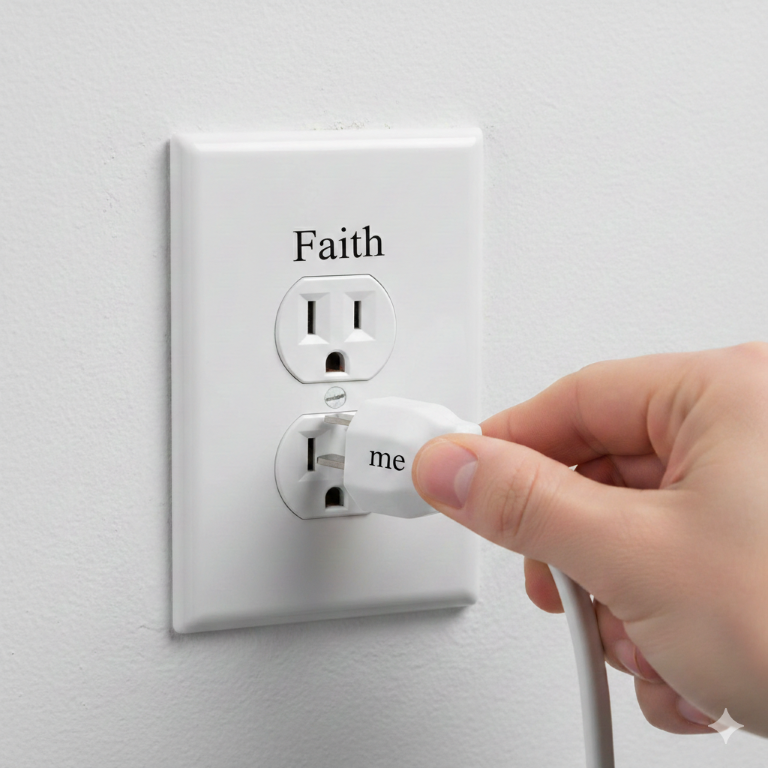
I wake up in the morning and the day begins.
I have no intention to make a dramatic rebellion against God.
No conscious decision to abandon my faith.
Just… a day. I probably say, “Good morning, Lord.”
Then I get out of bed, check my phone, scroll past something terrible, something annoying, something I didn’t need to know before coffee.
I get dressed. I think about the day. I respond to messages.
I start doing the things—appointments, responsibilities, conversations, expectations.
And faith is in there somewhere.
I know what I believe. I can explain it. I would defend it.
It’s just… not always running the show.
I know what living faith looks like. I just don’t always look like it—especially before noon.
I want it to overflow naturally. You know…
I want patience and kindness to show up without having to try too hard.
I want to respond to people the way Jesus would, the way I know I should.
But instead, too often there’s irritation.
Defensiveness.
All the business of the day makes me slightly less generous with my words, and my time, and my attention than I would like to be.
Nothing scandalous. Just small disconnects that add up to a life that looks related to faith—but not always driven by it.
But I don’t wake up intending to ignore God.
I just wake up and live… a day in the life.
And at the end of the day, pretty much every day, I realize I’ve been at least slightly different than what my faith and faithfulness are actually supposed to look like.
Can you relate?
We’ve spent the last couple weeks talking about what living faith looks like. James pointed out that faith without works is dead. Galatians showed us what the Fruit of Spirit is supposed to be. So if we’ve been paying attention, the question isn’t what living faith looks like—the question is why we don’t see more of it in ourselves.
Here’s what most of us know about the Christian life…
Most of the time, we don’t struggle with belief.
We’re not waking up every morning thinking, “I wonder if God is real today.”
We know Someone created all this, we believe in Jesus. We agree with Scripture. If someone asked us what being a Christian is supposed to look like, we could give a pretty solid answer.
That’s not the problem.
The problem is connecting that to our actual life.
We like the idea of growing in our faith—spiritual growth.
We like the concept of living faith instead of dead faith.
We’re very supportive of it… 10 out of 10… in theory.
But prayer becomes something we do as a last resort when things get bad.
Scripture becomes optional—like filling out the extended warranty on a toaster.
Worship becomes negotiable—“If nothing better is going on.”
Church becomes something we fit in when it’s convenient, right after kids’ sports, work, exhaustion after staying up too late watching whatever Netflix auto-played next.
Don’t want to start the week off tired!
We’d rather start the week blowing off the source of our true life.
We’re not being deliberately rebellious.
We’re just busy.
We’re just tired.
We’re just being normal people who don’t pray very much, or read the Bible very much, or go to church very often.
But then we’re confused when faith doesn’t overflow or grow or show up in everyday life.
We’re surprised when patience is always running thin.
When we’re constantly frustrated with people and ourselves.
It’s not because we don’t believe.
It’s because we’re disconnected.
We’re trying to live a full-time living faith on a part-time connection.
In John 15:4–5 Jesus says…
“Abide in me, and I in you. As the branch cannot bear fruit by itself, unless it abides in the vine, neither can you, unless you abide in me. I am the vine; you are the branches. Whoever abides in me and I in him, he it is that bears much fruit, for apart from me you can do nothing.”
Jesus isn’t giving advice; He’s letting us know how life works.
When He talks about “abiding,” He’s not talking about a vibe.
This isn’t about a mystical feeling. It’s not a spiritual mood you fall into when the music is just right and the coffee’s working.
Abide means to remain.
To stay.
To settle in. To live there.
To make your home somewhere instead of just stopping by.
In John 15, Jesus isn’t saying, “Think about me occasionally.”
He’s saying, “I am your life. Don’t unplug.”
Because abiding also means you stay connected—not just informed.
We don’t just know things about Jesus; our life is in Christ.
He’s not a resource we access when things go sideways.
He’s the source we’re to be plugged into all the time.
The metaphor is a branch, and a branch doesn’t check in with the vine once a week.
It doesn’t say, “Hey, I’ve got a lot going on right now, but I’ll circle back later.”
It either stays connected… or it shrivels up. There’s no third option.
So to abide in Christ is to order our life in a way that keeps us close—connected:
His Word keeps shaping us—not once in a while
His voice always has our attention to be heard
His gifts are being received again and again like clockwork
Abiding isn’t about doing more for Jesus.
It’s about staying close so He can keep our faith alive—do more for us.
And that’s why abiding always comes before fruit.
Because fruit doesn’t come from effort—it comes from connection.
Okay. So, we need to abide? It’s not a word we use very often. Other than The Dude abides, but how does he abide? Sorry, 90s movie reference that some of you were already thinking about.
Psalm 1:1–3 (ESV) says,
“Blessed is the man who walks not in the counsel of the wicked, nor stands in the way of sinners, nor sits in the seat of scoffers; but his delight is in the law of the Lord, and on his law he meditates day and night. He is like a tree planted by streams of water that yields its fruit in its season, and its leaf does not wither. In all that he does, he prospers.”
Another Bible word: “blessed.” it doesn’t mean lucky—or happy.
It doesn’t mean things will be easy.
And it definitely doesn’t mean without pain.
“Blessed” means living in the good that comes from being connected to God.
It’s the deep, steady kind of good that comes when your life is ordered around the way God designed things to work. Not because everything goes your way—but because you’re rooted in something that holds. It’s what happens when we abide.
In Psalm 1, the blessed person isn’t described as wealthy, comfortable, or admired. They’re described as planted. Connected.
Drawing life from the right source.
So “blessed” is not:
“Nothing bad happens to you”
“You always feel happy”
“God gives you what you want”
“Blessed” is:
Your life has meaning and direction
You’re able to stand when things are hard
You bear fruit in season
To be blessed is to be anchored, deeply rooted, even when the wind picks up.
That’s why the Bible can call someone blessed even when their life is difficult—because blessing isn’t about circumstances. It’s about where your life is planted.
So, Psalm 1 gives us a pathway for how to be blessed. How to abide.
The blessed person delights in God’s word. His wisdom, His commands, His promises.
Instead of being obsessed with the things of this world and letting them grow in us—the works of the flesh. Sin. All the relationally destructive patterns that drag hell into our lives and ruin everything. They directly oppose love, joy, peace, patience, kindness, goodness, faithfulness, and self-control.
Remember the parable of the seeds? Jesus says the kingdom of God is like a man who scatters seed on the ground. Whether the seeds grow and flourish has everything to do with how connected the roots are to the source of life. All of us were planted in this world among thorns, Jesus said in…
Mark 4:18–19 (ESV)
“The cares of the world and the deceitfulness of riches and the desires for other things enter in and choke the word, and it proves unfruitful.”
If we don’t abide in Christ, connected to the vine, we’re going to get choked out by weeds. Weeds don’t need encouragement. They just need neglect. A big difference between a garden full of weeds where nothing else can grow and a healthy garden is how often the weeds are pulled. Something’s going to grow, the question is what. Weeds, desires of the flesh or fruit of the Spirit.
We choose convenience over staying connected to the source. We let the culture schedule us out of worship, and we let the busyness of the day push prayer and Bible reading to the sidelines—nice when we can get to them, but not essential to how we actually live.
And then how we actually live starts to look more and more like the world around us instead of the way of Jesus. And then, like James said,
“faith by itself, if it does not have works, is dead.” James 2:17 (ESV)
That’s not what any of us want. None of us want dead faith.
So, here’s the good news, Jesus said…
John 15:9 (ESV)
“As the Father has loved me, so have I loved you. Abide in my love.”
This actually puts what Jesus said earlier in a different light. Jesus doesn’t say earn my love, He says “abide” in it. Remain in it. Live in it. Make it your home.
Abiding in His love isn’t how we get His love. It’s not how we achieve His love. He freely gives it to us, He just wants us to live in it. Remember it. Abiding isn’t work, it’s rest.
It’s like being told, “You don’t have to hold your breath anymore.”
Like you’ve been trying to hold your breath because you think you’re under water—Jesus is saying, “The air here is good. You’re safe. You can breathe.”
That’s not a command that adds pressure. It’s a release from it.
It’s like Jesus gave us a key to His house, our own room, and told us to make ourselves at home—but we insist on ringing the doorbell, asking if we can use the restroom, always wondering if we’ve overstayed our welcome.
Jesus isn’t saying, “If you behave, you can stay… I guess.”
He’s saying, “This is your home now. Unpack. Abide.”
Abiding doesn’t mean you have to stay good enough.
It also doesn’t mean there aren’t house rules but…
This is the opposite of being handed something heavy.
This is Jesus saying you can put your heavy burden down. And leave it down.
His burden is not only light, it’s good for you.
Abiding is a promise. It’s a relief.
Abiding in Christ is a burden like having to eat lunch is a burden. And like then having to enjoy dessert is a burden. Like having to sleep is a burden—when we refuse to abide in Christ, we’re acting like a toddler who refuses to go to bed. Sleep isn’t a punishment, it’s a gift. Eventually your body says, “Okay, buddy… enough of this foolishness. You need this.”
Having to abide in Christ is like having to charge your phone. Our family is all on this app called Life360. It tells me how charged everyone’s phone is. When I was writing this message, Angel was at 30%, Von was at 35%, and Kim was at 75%. Imagine if it also told me how well they were spiritually charged from being connected to the Lord. I want that app for me. Abiding is staying plugged in.
The whole point of what Jesus did for us, that we’re supposed to abide in, is that He forgives us all our sin and makes us right with God. It’s all grace. The whole point is that we trust His word on that—He made us right with God. We don’t have to add anything to it. The phone can’t charge itself, neither can we. We get salvation purely by faith. Paul said it like this…
In Romans 8:1–2 (ESV)
“There is therefore now no condemnation for those who are in Christ Jesus. For the law of the Spirit of life has set you free in Christ Jesus from the law of sin and death.”
There is no condemnation for you who are in Christ Jesus—who are abiding in Christ Jesus. Just resting in Him.
Because of Jesus, a new reality is now at work in you. The Spirit brings life, not condemnation. What used to trap you—sin, guilt, and the slow pull toward death—no longer has the final say. The Spirit of God has given you life in Christ, and connection to His life has broken the power of sin and death over you.
That’s not advice.
That’s an announcement.
Abide in that. It’s good news.
… But how? And here’s the problem. “How” always sounds like soul crushing obligation and rules. Law. Commands.
How to get healthy: Eat your veggies! Drink more water! Go to bed on time!
Abiding isn’t white-knuckling a better spiritual routine. Abiding is trusting in Jesus who refuses to let go of you—by giving you His gifts through word and sacrament, and Christian community.
Abiding is just normal everyday ordinary faithfulness.
1. Daily Scripture
Joshua 1:8 (ESV)
“This Book of the Law shall not depart from your mouth, but you shall meditate on it day and night, so that you may be careful to do according to all that is written in it.” The word for meditate is the same word for when a cow chews its cud—not depart from your mouth, keep it in your mouth, it’s comforting and you’ll get more out of it the more you chew on it. This is God reminding us to stay in His word and we won’t lose our way in what He’s called us to do.
So, yeah. Abide means read your freaking Bible. Believe your freaking Bible, and do what it freakin’ says. Not to earn anything, but to receive everything.
2. Daily Prayer
In Matthew 6:9–13 (ESV) The Lord’s Prayer. Jesus taught us a simple, daily prayer. It contains everything it means to abide in Him. I don’t have time to explain that right now but as I pray it every day, I learn more and more the depth of it. I pray the words as I have memorized them, then I go back through part by part and put it in my own words.
Philippians 4:6 (ESV)
“Do not be anxious about anything, but in everything by prayer and supplication with thanksgiving let your requests be made known to God.” This is a command that’s a lot like “Abide in Christ” because it’s not like, “Hey loser! Stop being anxious! Being anxious is a sin. Sinner!!!” It’s not like that. It’s like when a child is afraid of the dark and you tell them as gently and tenderly as you can, “It’s okay… I’m here… you don’t have to be afraid.”
So, yeah… to abide in Christ means to pray. But it’s not a heavy burden. He just wants you to talk to Him. He’s always more willing to listen than we are to pray. It doesn’t have to be some big, emotional, flowery prayer. Just talk to Him. Simple prayers are fine.
3. Go to Church
In the Old Testament the word for congregation (qahal / kuh-HAHL) was often translated into Greek as ekklesia, which is the word translated as “church” in the New Testament.
Like in Psalm 22, which is a description in the Old Testament of the Messiah being crucified, it says, “I will tell of your name to my brothers; in the midst of the congregation (the church) I will praise you: You who fear the Lord, praise him!” and verse 25,
“From you comes my praise in the great congregation (Church); my vows I will perform before those who fear him.”
So, understand this… when the Bible talks about the church, it’s talking about the congregation of Christians who come together for worship. Jesus said the point of what He did was to build His church. Let’s not pretend gathering for church isn’t important.
One of the ways we abide in Christ is be faithful to gather as His church—it’s how He feeds us and gives us so many of the gifts He wants to give us.
Hebrews 10:24–25 (ESV) says,
“And let us consider how to stir up one another to love and good works, not neglecting to meet together, as is the habit of some.”
Acts 2:42 (ESV) says,
“And they devoted themselves to the apostles' teaching and the fellowship, to the breaking of bread and the prayers.”
The early church understood this. Community is where faith gets practiced, corrected, encouraged.
Acts 20:7 (ESV) Paul says,
“On the first day of the week, when we were gathered together to break bread….”
This is worship.
Let’s be brutally honest about this. Most Christians attend church about 1.5 times a month—that’s a recipe for starving our faith and how to slowly kill a local church.
Abiding in Christ means we don’t fit worship into our lives.
We build our lives around it.
But don’t hear any of that as condemnation, hear it as an invitation. You’re a branch Jesus is calling back to the vine.
So let me end where I started—with me.
Because here’s what I know, when I’m disconnected, I don’t love very well.
I'm short with people. I get distracted. I get self-focused.
I still believe all the right things—I just don’t look like it.
But when I abide—when I stay close—stay plugged in—something changes.
Not instantly. Not magically. I change.
Faith takes a more central place in the everyday.
I’m a little more patient.
A little more generous.
A little less defensive.
A little more about the people in my life than what’s in it for me.
Not because I finally started trying harder.
Just because I stayed connected.
This sermon isn’t about trying to be a better Christian.
It’s not about adding more religious burdens to your life.
It’s about staying close to the One who already loves you, already forgives you—who is already the true source of your life.
Abiding doesn’t mean you’ll never stray off the straight and narrow.
It means when you realize you have, you remember where home is.
You know how you go on autopilot when you’re driving home? You meant to stop at the store or to get gas but the next thing you know, you’re in the driveway ready to walk in the house?
Abiding in Jesus is like that. You spend enough time plugged into the source through meditating on God’s word, praying, going to worship and discipleship groups with your Christian friends that your soul just automatically knows the way home.
So if you feel tired, distracted, dry, or just ready to admit your faith feels thinner than you’d like—this isn’t a rebuke.
It’s an invitation.
Come back to the source.
Stay connected.
Abide.
Because living faith isn’t something you manufacture.
It’s something that grows when you stay close to Jesus.
And He’s already promised to stay close to you.