
"Intellectual Capital"
A couple weeks ago we started talking about something called the Five Capitals. It’s a framework some friends of ours in a church planting network called the Harvest Partnership use to think about how the church actually grows and carries out the mission of Jesus.
The basic idea is pretty simple. The church is made up of what the people in the church bring to the table. Not just money. Not just volunteers. Everything.
Spiritual Capital. Relational Capital. Intellectual Capital. Physical Capital. Financial Capital.
All the different blessings God has given each of us.
We’ve talked about Spiritual and Relational Capital. Today we’re talking about Intellectual Capital.
Which probably sounds like something from a business conference. Like we’re about to talk about synergy, productivity metrics, and quarterly reports. So, if you’ll turn in your prospectus to page 307..
Intellectual Capital Here’s the big idea for today: God gives every Christian knowledge, skills, and abilities—and He expects us to use them for the mission of the church.
Everything you know. Everything you’ve learned. Everything you’ve practiced over the years and picked up in your various adventures of life.
All your kung fu and superpowers.
Anything you’ve learned or been trained in is what I call your kung fu.
Whatever you’re naturally better at than most people is what I call your superpowers.
We all have both.
That first job where you washed dishes and learned how to work efficiently.
That summer you spent mowing lawns and figuring out how to deal with customers and budget money.
That first boss who taught you how to show up on time and do the job right.
That home repair where you learned how to swing a hammer and measure twice, cut once.
That team you coached where you learned how to motivate people and keep everyone moving in the same direction.
That project where you figured out how to organize and communicate so things don’t fall apart.
That budget where you learned how money works and how decisions affect people.
That skill you’ve developed—music, photography, woodworking, fitness, martial arts—where you worked at something long enough that you actually got good at it.
That moment when someone asked you for help and you realized you knew how to do something they didn’t.
All those little moments. All those things you’ve learned along the way.
That’s your kung fu.
Superpowers and Kung Fu
One of my favorite things in life is watching someone who really knows what they’re doing do what they do. It can bring tears to my eyes.
A gymnast landing an impossible flip. A centerfielder throwing someone out at home.
A mechanic listening to a car engine for five seconds and going, “Yeah… that’s the water pump.” While I stand there thinking, “Uh huh… I hear car noises, too.”
Or a contractor walking into a house and immediately saying, “That’s not a load-bearing wall— it doesn’t have to be there.” Which is cool but I didn’t know walls had such sensitive feelings or need to belong.
Or a musician who can hear a song once and immediately know all the chords—even if it wasn’t played on guitar—which seems like voodoo to me. Pianos are mysterious. Ha.
Or a graphic designer who looks at a church flyer with twelve cool fonts and some awesome clipart and whispers quietly, “Yikes.”
Everybody knows something. Everyone has skills. We all have abilities.
Some people can teach, others know how to lead, some are great at organizing, others know how to build stuff, or how to fix things, or how to design things—some people know how to explain complicated ideas so they can be understood.
Some of us understand technology, and computers, how to do video editing, the nuances of social media, the theory behind sound systems, or best practices in marketing.
We are not all the same. We bring different things based on our experiences and interests. There’s all kinds of us, even here in this little church…
We bring all kinds of things to the table. All of it matters. All of it is Intellectual Capital.
We know what we know—and we’re usually more critical of those things than anyone else. I used to be a trim carpenter, so I’ve never seen a crown molding that I didn’t think I could have done better. Ha.
And I suspect a lot of you feel the same way. You’re secretly critical of the things you are good at. Also, you know your own areas of expertise so well that you assume it’s not that special or useful. You assume it’s not really spiritual and brings no value to the church. We compartmentalize everything into what we think of as sacred and secular.
Which makes us think the church is only about a few particular kinds of spiritual gifts—preaching, singing, maybe prayer. But the Bible actually shows God using all kinds of abilities.
One of my favorite examples is in Exodus. God is describing the building of the tabernacle—the worship space for Israel. And He says this about a man named Bezalel.
Exodus 31:3
Then the LORD said to Moses, “Look, I have specifically chosen Bezalel son of Uri, grandson of Hur, of the tribe of Judah. I have filled him with the Spirit of God, giving him great wisdom, ability, and expertise in all kinds of crafts. He is a master craftsman, expert in working with gold, silver, and bronze. He is skilled in engraving and mounting gemstones and in carving wood. He is a master at every craft!”
Interesting… God “filled him with the Holy Spirit.” To make stuff. Apparently the Holy Spirit is not only interested in sermons. He’s also interested in doing ordinary things.
The Spirit doesn’t just empower prophets. The Spirit empowers artists and craftsmen.
God didn’t drop the tabernacle from heaven. He used the knowledge and ability of His people.
Different Gifts, Same Mission
Paul talks about this in Romans 12:6
“In his grace, God has given us different gifts for doing certain things well. So if God has given you the ability to prophesy (which just means to say what God says—that’s all prophesy is), speak out with as much faith as God has given you. If your gift is serving others, serve them well. If you are a teacher, teach well. If your gift is to encourage others, be encouraging. If it is giving, give generously. If God has given you leadership ability, take the responsibility seriously. And if you have a gift for showing kindness to others, do it gladly.”
Teaching. Leading. Serving. Encouraging. All gifts we bring to the church.
And then in Ephesians Paul says something really important. He says Jesus gave the church specific gifts “to equip the people in the church for the work of ministry.” [Ephesians 4:11] “Now these are the gifts Christ gave to the church: the apostles, the prophets, the evangelists, and the pastors and teachers. Their responsibility is to equip God’s people to do his work and build up the church, the body of Christ.”
Notice the pastor isn’t the one doing all the ministry. The apostles, prophets, pastors, and teachers are supposed to equip everyone else to do the ministry to build up the church. Let me say that again: The pastor is supposed to equip everyone else to do the ministry of building up the church. Every church is unique with different people who have different abilities, different ways to minister to the community—and the church is only able to do what God specifically called that church to do when everyone brings what they have to the table.
This is why the Five Capitals idea is helpful. It reminds us that the church is basically a big table where everyone shows up bringing something.
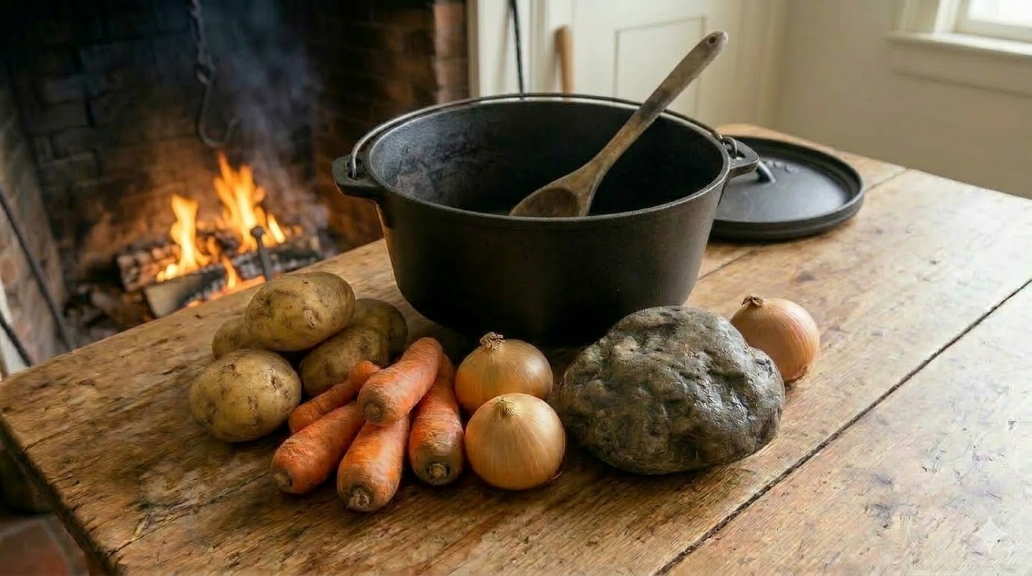
There’s an old story called Stone Soup. A traveler’s walking down a road toward a village. He’s hungry. Not just “I skipped lunch” hungry, but the kind of hungry where you start wondering what tree bark tastes like.
Before he gets to town, he picks up a stone from the side of the road and puts it in his pocket.
When he gets there, he starts asking around.
“Excuse me, I’m traveling through and I was wondering if anyone might have a little food to spare.”
They’re like, “Sorry.”
Everyone turns him down, “Times are hard, we don’t have any extra.”
But he figures everybody has a little something.
So he says, “Oh, that’s alright. I’ll just make stone soup and share it with everyone.”
They look at him like he lost his mind. “Stone soup?”
He pulls out the rock. “It’s pretty great. Does anyone have a pot?”
Someone says, “Well, I guess you can borrow mine.”
“And some water,” the traveler says.
Someone brings water.
He drops the stone into the pot and a couple people help him get a fire going under it.
Everyone’s curious. A crowd starts gathering around this crazy guy cooking a rock.
After a few minutes the traveler tastes the soup…
“Hmm… it’s getting there. Of course, it would be even better with a few carrots.”
One villager says, “Well… I do have a few carrots.”
A little while later the traveler tastes it again…
“Definitely coming along. But you know what would really help? A couple potatoes.”
Someone else says, “I’ve got a potato.”
A couple other people say, “Me, too!”
Into the pot they go.
Then someone brings an onion.
Someone else some cabbage.
Someone adds a little salt and pepper.
A couple hunters bring some meat.
And before long the whole village is gathered around this giant pot of soup that smells yummy. Everyone brought a little something and suddenly there’s enough to feed the whole village.
All the people are like, “Who knew you could make soup out of a rock?”
Pretty good picture of the church.
We all bring what we have, what God has already given us, and something beautiful happens. Suddenly there’s a gathering, a community and more than enough to go around.
The Problem
But here’s the problem. Most Christians assume what they have doesn't really matter in the church. A small bag of potatoes that’s starting to grow eyes. A weird looking carrot. A bag of frozen peas with some frost on it.
People think, “I’m not a pastor. I’m not a musician. I’m not a theologian. So I really don’t have much to bring.”
But that’s not how the church works.
The church needs people who know practical skills.
The church needs people who know how to build things, fix things, explain things, lead things, and organize things.
You know… the things you know how to do. God didn’t just give those abilities to you for you. He gave them so you could bless other people. Ephesians 2:10 says God saved you to
“do good works that He created in advance for you to do.”
We all bring prayer. We all bring faith. We all bring hospitality. We all bring wisdom. We all bring encouragement. Some of us bring music. Some of us bring teaching. Some bring business insight. Bible knowledge. Technical skills. Construction experience. Design creativity. Organizational ability. Physical strength.
But it’s not just about what happens inside these walls.
Another question is: What do you know how to do that could help us connect with people who need to be here?
Maybe you know how to organize a BBQ and invite the community.
Maybe you love movies and want to organize a movie night.
Maybe a fantasy football league?
Maybe you want to put on a concert for kids at the park.
Maybe you want to have a children’s discipleship group at your house during the week? Let’s come up with ideas no one else has thought of!
What do you know how to do, or like to do… that could be a way for people to connect to our church?
Those things are bridges to people. Ways to connect people to Jesus.
Stewardship
This is where the idea of stewardship comes in. A steward is someone who manages something that belongs to someone else.
Some of us understand this concept when it comes to money. But we don’t apply the idea of stewardship to our knowledge, our abilities, our intelligence, our skills— even though those things belong to God too. Those things are all given to you in God’s providence and wisdom.
He entrusted those things to you.
So the question is: What are you going to do with what God gave you?
The Parable of the Talents
Jesus told a story about this. A master is going to be gone for a long time and gives his servants different amounts of money. A talent was a very large weight of silver or gold—worth about 20 years of wages, an entire lifetime of wages.
Matthew 25:14 Jesus says,
“[The kingdom of heaven] will be like a man going on a journey, who called his servants and entrusted to them his property. To one he gave five talents, to another two, to another one, to each according to his ability. Then he went away. He who had received the five talents went at once and traded with them, and he made five talents more. So also he who had the two talents made two talents more. But he who had received the one talent went and dug in the ground and hid his master’s money. Now after a long time the master of those servants came and settled accounts with them. And he who had received the five talents came forward, bringing five talents more, saying, ‘Master, you delivered to me five talents; here, I have made five talents more.’ His master said to him, ‘Well done, good and faithful servant. You have been faithful over a little; I will set you over much. Enter into the joy of your master.’ And he also who had the two talents came forward, saying, ‘Master, you delivered to me two talents; here, I have made two talents more.’ His master said to him, ‘Well done, good and faithful servant. You have been faithful over a little; I will set you over much. Enter into the joy of your master.’ He also who had received the one talent came forward, saying, ‘Master, I knew you to be a hard man, reaping where you did not sow, and gathering where you scattered no seed, so I was afraid, and I went and hid your talent in the ground. Here, you have what is yours.’ But his master answered him, ‘You wicked and slothful servant! You knew that I reap where I have not sown and gather where I scattered no seed? Then you ought to have invested my money with the bankers, and at my coming I should have received what was my own with interest. So take the talent from him and give it to him who has the ten talents. For to everyone who has will more be given, and he will have an abundance. But from the one who has not, even what he has will be taken away. And cast the worthless servant into the outer darkness. In that place there will be weeping and gnashing of teeth.’ “When the Son of Man comes in his glory, and all the angels with him, then he will sit on his glorious throne.
Three servants. The first two put their talents to use and doubled the money. The master says the same thing to both of them: “Well done, good and faithful servant. Enter into the joy of your Lord.” The third servant buried his because he was afraid. Notice that word: afraid. He does nothing with the talents he was given. The Lord is not pleased and the servant is sent to the bad place. Kind of a scary story.
It’s fascinating that the word “talent” originally just meant money, but because of this parable it eventually came to mean a God-given ability or gift. In other words, the way we use the word talent is a direct result of Jesus’ teaching: use the abilities God has given us...
Don’t just sit in the back row and assume someone else will do the work.
But the church needs what you have to bring.
This connects back to Luke 10:02. Jesus says,
“The harvest is plentiful, but the workers are few.”
Workers aren’t just pastors. Workers are everyone.
The harvest needs teachers, leaders, problem-solvers, creative people—people who understand culture, who understand technology, people who understand people.
The Gospel
All this talk about bringing your talents to church or God’s going to be mad at you probably sounds a little intimidating. I certainly don’t want to push anyone into a cycle of church burnout—there’s enough of that already.
So, here’s the most important thing I’m going to say today: Your value to God is not based on the abilities He gave you. That wouldn’t make any sense—He’s the One who gave you those talents in the first place.
He gave you those things because He loves you. God didn’t save you because you’re useful. He didn’t choose you because you’re impressive. That’s getting everything backwards.
He chose you because of Jesus. It’s all grace.
Jesus lived the life you couldn’t live. He died for your sins. He rose from the grave.
Your place in His kingdom is secure before you ever contribute anything to it.
And because you are already loved, already forgiven, already saved, now you get to bring what you have to the table.
Not to earn God’s love. Again, that doesn’t make sense, because you only give back to Him what He’s already given you. And when we do those things in His service, that’s where we’re going to find freedom and purpose.
Closing
So here’s the question.
What abilities has God given you through all the adventures in your life?
What knowledge? What skills? What experiences? What wisdom? What hobbies? What are you interested in? What are you critical of? What do people ask you for help with?
Those are clues. What are your superpowers. Your Kung Fu.
Your Intellectual Capital. Your talent. Don’t bury it.
It’s what you have to contribute to this NewChurch stone soup.
Very soon I’m going to be asking if you want to join a special task force to come up with ways that we can connect to the community around us. Be thinking about what you have to bring to that discussion. Be ready to bring it to the table.
The harvest is ready.
And the church needs what only you can bring. Amen.