
"Romans Flyover MSOTB"
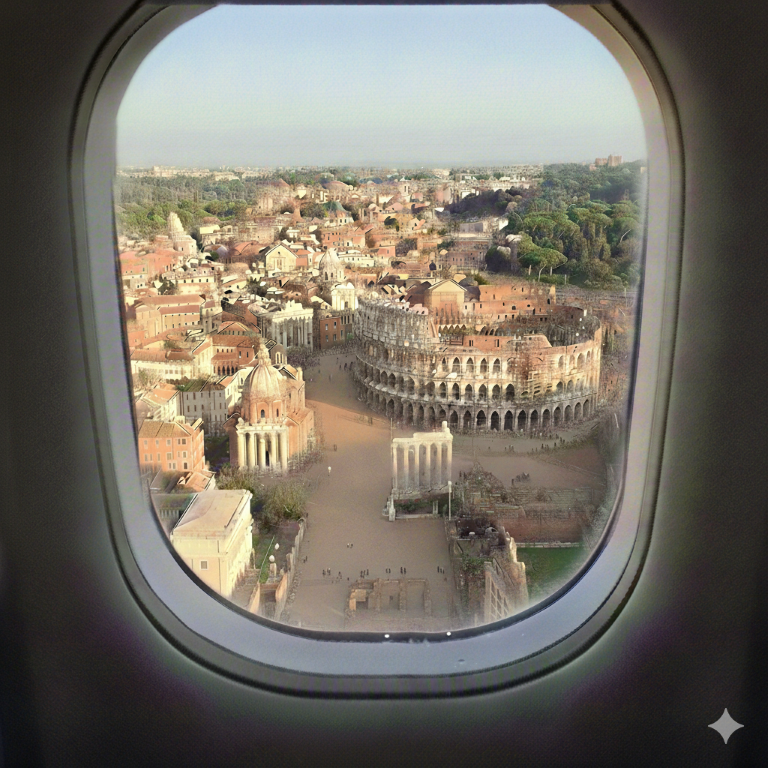
I’ve always wanted to go to Rome. Look at all the ancient sites. Tour some pretty churches. Eat some real Italian food. Find out if the McRoyal is better than a Quarter Pounder with Cheese.
The Apostle Paul had never been to Rome, either. It seemed to be a true bucket list thing for him. It was already a very ancient city—over 800 years old. It was also the center of power, law, culture, and civilization. He really, really wanted to preach the Gospel there.
But the Gospel got to Rome before Paul did. Some of the people who were in Jerusalem for Pentecost—on the day when the Holy Spirit showed up with tongues of fire and about three thousand people were baptized—a bunch of them were from Rome. And they took Jesus home with them and started some churches. All without an official apostle.
Usually, Paul’s letters were to churches he had planted. But the Book of Romans is a letter Paul wrote to churches he had never been. He had some friends there and he was planning a visit in the near future. He had heard a lot of good things.
But he’s not just going as a tourist or to catch up with friends.
He’s going to ask them for money to fund his ministry.
He wants their support.
He wants their help to go beyond Rome—places where the Gospel had never been preached and churches didn’t exist.
But before he asks for their money…
Before he asks for their partnership…
He wants to make sure they’re on the same page. He wants to be absolutely clear they understand what the Gospel is before they help him spread it to the rest of the world.
So this is the clearest explanation of Christian doctrine in the New Testament.
Romans is the book you read and then feel like you need to sit down and rethink your entire life.
The Situation in Rome
The Roman church was a mixture of Jews and Gentiles.
Some grew up very strict keeping the Law of Moses.
Some grew up having theologically normalized sex in the temples of Venus.
They were not the same.
You can imagine what they thought of each other.
Behind their polite church smiles was some real tension. And part of the reason for that tension was history. About five years earlier, Emperor Claudius kicked all the Jews out of Rome. When they were finally allowed to come back, they returned to churches that had become almost entirely Gentile in practice. Same Gospel. Very different lifestyles. Lots of arguments over Sabbath, food laws, and Jewish customs. Some really big questions:
Do Gentiles need to act like Jews to follow Jesus?
Does the Law of Moses still define who God’s people are?
And the hundred-million-dollar question: what does it mean that so many Jews have rejected Jesus? What’s going on with that?
The Book of Romans is Paul answering all those questions.
I’ve been doing a series called Making Sense of the Bible where I cover a book in one sermon.
Today we’ll do a flyover of Romans.
Romans 1 — The Gospel and the Human Problem
Paul starts by declaring the heart of the Gospel right out of the gate:
God is saving the world through Jesus Christ.
This salvation is for Jew and Gentile alike.
Righteousness is by faith, not by acting a certain way.
When Paul talks about ‘righteousness,’ he doesn’t just mean a moral scorecard. He means who God is. God is righteous—He always does what is right, and He is faithful to keep His promises. So when the Gospel reveals God’s righteousness, it means God is keeping the promises He made to Abraham, to Israel, and now to the whole world through Jesus.
That’s the headline.
Then Paul backs up—to explain why salvation is necessary at all.
He says everyone knows there is a God.
Creation makes it perfectly clear there was a Creator.
The problem isn’t ignorance—we just try to ignore the evidence so we can do what we want.
First Paul paints a picture of the world from a Gentile perspective:
He points out the obvious idolatry: instead of worshiping the Creator, they worship created things. And all this false worship leads to complete moral collapse.
Romans 1:24-32 (NLT) says,
“So God abandoned them to do whatever shameful things their hearts desired. As a result, they did vile and degrading things with each other’s bodies. They traded the truth about God for a lie. So they worshiped and served the things God created instead of the Creator himself, who is worthy of eternal praise! Amen.”
He goes on to describe the full moral collapse—sexual disorder, every kind of deviation from God’s intentions, relational breakdown, violence, pride, cruelty—ending by saying they not only do these things, but celebrate them and make up new ways to sin every day. Pretty much the same thing we still do now.
Paul’s not holding back but he’s not being edgy, either. He’s saying: when worship goes wrong, everything goes wrong.
And just when the Jewish readers were nodding along like, “Yeah! Pagans! We’ve been telling you Gentiles that you need to be more holy—like us.”
Paul turns toward them… and religious people in general.
Romans 2 — The Religious Turnaround (You’re Not Better)
You think you can judge them?
You’re just as bad.
Knowing Bible verses, having the Law doesn’t save you.
Knowing what God wants doesn’t change your heart.
Circumcision doesn’t make you right with Him.
The Law was never meant to be a badge of superiority.
So Paul knocks down their religious confidence:
The Jew is not saved because they have the Law.
The Gentile is not condemned because they don’t have it.
Everyone stands before God in their own sin.
Romans 3 — Total Collapse, Then Total Grace
No one is sinless. No one is right with God.
Not Gentiles.
Not Jews.
Not religious people.
Not moral people.
There is no one who is good. Not one person. Think of the best, sweetest person you can think of… not even them.
Man on the street interview: Do you think you’ll go to heaven when you die? The person is like, “Sure, of course.”
Why do you think that?
Nine times out of ten they’ll say, “I think I’m a pretty good person.”
God says, “Nope. You’re not.”
This is the moment where all self-justification dies.
No one can hear the Gospel if they don’t think they need it. So, Paul makes it clear that everyone does.
And then, the Gospel. Chapter 3 verse 21,
“But now God has shown us a way to be made right with him without keeping the requirements of the law, as was promised in the writings of Moses and the prophets long ago.”
God reveals righteousness apart from the Law.
Not earned.
Not deserved.
Not achieved.
Justified by grace.
Through faith.
Because of Christ.
The Law does its job, it diagnoses the problem.
Jesus fixes it.
When I was a new Christian and going to Bible College, we were taught to share the Gospel using something they called “The Roman Road.”
Here’s my LCMS updated version of it…
The Roman Road (The Lutheran Way)
If you trace Paul’s argument through Romans, he lays out a clear way of explaining the Gospel to people. Start with…
Romans 3:23
“For all have sinned and fall short of the glory of God.”
All.
Then comes the consequence.
Romans 6:23
“For the wages of sin is death (But Paul doesn't leave you there) but the free gift of God is eternal life in Christ Jesus our Lord.”
And nothing is really free, so what actually paid for your free gift?
Romans 5:8
“But God shows his love for us in that while we were still sinners, Christ died for us.”
And how do you get your free gift?
Romans 10:9
If you openly declare that Jesus is Lord and believe in your heart that God raised him from the dead, you will be saved. For it is by believing in your heart that you are made right with God, and it is by openly declaring your faith that you are saved.
Because Romans 10:13 says…
For everyone who calls on the name of the LORD will be saved.
The Romans road is God walking to you.
Romans 4 — This Was Always the Plan
This sounded weird to the law obsessed Jews so he goes all the way back to Abraham.
Before Moses.
Before Sinai.
Before circumcision.
Abraham was justified by faith.
Which means he just trusted God instead of trusting himself.
And that was enough for God to save him from his sin.
So, to any of the Jews who were paying attention, that means:
Salvation was never ethnic.
It was never merit-based.
It was never earned.
Faith doesn’t earn a right standing with God.
Faith just receives it.
Romans 5 — Peace, Not Performance
Paul explains what justification means—what does being right with God produce?
It produces peace with God.
Your sin is no longer a target for the wrath of God. That sounds pretty good.
Peace.
Then Paul compares Adam and Jesus.
Adam brought sin and death to everyone. We’re all born into sin and headed for death.
Jesus brings righteousness and life to anyone who hears and believes what Jesus did for them.
Paul’s bigger point here is that there are really two kinds of humanity. An Adam-like humanity—defined by sin, fear, and death. And a Jesus-like humanity—defined by trust, sacrificial love, and life. Baptism in Romans 6 and life in the Spirit in Romans 8 are how God moves us from one humanity into the other.
So, it’s not about keeping God’s rules, it’s about trusting in Jesus to save us.
And of course some of us hear that and think, “That’s a relief! Now I can do whatever the heck I want as long as I show Jesus my get out of hell laminated pass.”
Romans 6 — Grace Is Not Permission to Rot
Paul anticipates our dumb response:
“If grace is free, why not sin?”
The answer is because grace unites you to Christ.
In your baptism, you died with Him and you were raised with Him.
You have been changed.
You have a new identity.
Jesus bought you with the price of His life.
The world, the flesh, and the devil are no longer your master.
Sin is no longer your master.
Jesus says, “Follow me.” And He points in the direction of God. The direction of the kingdom of heaven. The path of the righteous. The Way of God’s wisdom.
Start walking. Don’t look back. Don’t veer to the right or the left. Follow Jesus. The Way.
Romans 7 — The Law Can Name the Problem, Not Solve It
The Law does point us in the right direction…
The Law is good.
But it can’t fix us.
We don’t want to sin. We hate what it does to us and our life and the people we love.
Disobeying God is at the center of all our problems.
But we still do it. Over and over.
This is the struggle as long as we’re on this side of forever.
The Law shows us which way to go. And tells us when we get off track.
But it never heals us.
The Law works like a magnifying glass. God took the human sin problem and focused it into one place—Israel—so it would be impossible to miss. Not so Israel could fix it, but so the whole world could see that it needs to be fixed.
This is why we need to return to Jesus for grace and forgiveness every day.
This is why Paul opens chapter eight with God’s declaration to all of us who are in Christ…
Romans 8:1
“So now there is no condemnation for those who belong to Christ Jesus. And because you belong to him, the power of the life-giving Spirit has freed you from the power of sin that leads to death.”
The Holy Spirit does what the Law never could:
Gives life
Gives assurance
Transforms our hearts so we can actually live out the command to love God and neighbor
You are no longer a slave to sin.
Sin still exists.
But it does not define your future.
God loves you and nothing can separate you from His love.
Nothing.
Romans 9–11 — What About Israel?
Then Paul addresses the hardest question.
If Jesus is the Messiah…
Why have so many Jews rejected Him?
Chapter 9, verse 2,
“My heart is filled with bitter sorrow and unending grief for my people, my Jewish brothers and sisters. I would be willing to be forever cursed—cut off from Christ!—if that would save them. They are the people of Israel, chosen to be God’s adopted children. God revealed his glory to them. He made covenants with them and gave them his law. He gave them the privilege of worshiping him and receiving his wonderful promises. Abraham, Isaac, and Jacob are their ancestors, and Christ himself was an Israelite as far as his human nature is concerned. And he is God, the one who rules over everything and is worthy of eternal praise! Amen.”
Romans 9–11 — What About Israel?
Why have the Jews rejected Jesus? Paul wonders the same thing. It breaks his heart. He says he would be willing to give us his own salvation and go to hell in their place if God would let him.
That’s something. I’ve often wondered who I would be willing to give up my seat at the heavenly table for.
But he wants them to understand…
God didn’t fail to keep His promise.
God hasn’t abandoned Israel.
Some will reject Jesus, the Messiah.
Some will believe.
Meanwhile, Gentiles are being grafted in.
Adopted into the family.
This was always the plan.
God hasn’t rejected Israel.
Jesus became Israel reduced to one perfect man to save all people from every nation.
Jesus does what Israel was supposed to do all along.
Create one unified new humanity—one holy people of God.
Everyone who is in Christ is now part of the true Israel.
Ethnic Israel was never the point—God’s promise was. And that promise has been fulfilled in Christ. That’s why Paul uses the olive tree image. God didn’t start over. He kept the same story, the same promise, the same root—and grafted the other nations into it through Jesus.
Israel still has a future and long as it is in Christ.
Paul points out that he’s a Jew and he wasn’t rejected.
He holds out hope that there are going to be many more of his Jewish brothers and sisters who will come to faith in their Messiah.
But the point is everyone is saved by trusting in Jesus Christ.
Jews and Gentiles alike.
Both are saved by grace through faith.
Romans 12 — Now What?
So now what? Now that you’re saved—now what?
The answer is obedience. Because obedience is a response, not a requirement.
Chapter 12,
“And so, dear brothers and sisters, I plead with you to give your bodies to God because of all he has done for you. Let them be a living and holy sacrifice—the kind he will find acceptable. This is truly the way to worship him. Don’t copy the behavior and customs of this world, but let God transform you into a new person by changing the way you think. Then you will learn to know God’s will for you, which is good and pleasing and perfect.”
A living sacrifice. That would have sounded strange—sacrifices are usually dead. But Jesus, the Lamb of God who takes away the sin of the world, is alive. And we’re alive in Him. So, we are also living sacrifices. Our life, our obedience, is our worship. Our living sacrifice.
Romans 13 — Life in the World
All areas of our life:
The way we live under authority
The way we obey the Law
Which, instead of just making us act like Jews, tells us how to love our neighbor
Even with our governments, Christians live in the world, not above it. Pay our taxes, vote, obey the law of the land as much as we can—as long as it doesn’t tell us to sin against God.
Romans 14–15 — Unity Over Preference
Get along with people in the church.
The Gospel matters more than winning arguments.
Or trying to force our way of doing things on other people.
Unity matters because the mission of the church depends on it.
Live at peace with each other in as much as it depends on you.
Stop fighting over the HangTime menu and whether to have church on Saturday or Sunday.
Remember the tension in the room—imagine how this letter landed.
Romans 16 — People
In the last chapter, Paul ends with a bunch of greetings and names.
And one of those names is Phoebe. She was a trusted leader in the church, and probably the one who carried this letter to Rome and read it out loud to the churches for the first time. So when we hear Romans, we should imagine hearing it through the voice of a faithful woman who knew these people.
The Whole Flow of Romans in One blast…
Everyone knows God.
Everyone rebels.
No one is righteous.
Christ saves by grace.
Faith receives salvation.
The Spirit assures salvation.
Israel is not forgotten.
All who are in Christ are the Israel of God.
The church is one body.
And the Gospel must go to the whole world.
That’s Romans.
At the end, Paul finally gets to the point of his letter.
It’s a fundraising letter.
Chapter 15, verse 24,
“I am planning to go to Spain, and when I do, I will stop off in Rome. And after I have enjoyed your fellowship for a little while, you can provide for my journey. But before I come, I must go to Jerusalem to take a gift to the believers there. For you see, the believers in Macedonia and Achaia have eagerly taken up an offering for the poor among the believers in Jerusalem. They were glad to do this because they feel they owe a real debt to them. Since the Gentiles received the spiritual blessings of the Good News from the believers in Jerusalem, they feel the least they can do in return is to help them financially. As soon as I have delivered this money and completed this good deed of theirs, I will come to see you on my way to Spain.”
Why Paul Wrote This Letter at All
He wants to go where Christ is not known.
He wants to preach where churches don’t exist yet.
And he wants the Roman church to be part of that mission.
He wants them to provide for his journey.
Romans is theology for the sake of mission.
Because a confused Gospel can’t be heard.
And a divided church won’t send.
We need to let people know what we know…
You are more sinful than you thought.
But you are more loved than you could possibly imagine.
Because Jesus has done everything required for your salvation.
That’s the Gospel according to Romans.
It’s for the whole world which means it’s for you. AMEN