
For When You Feel Like You’re Never Good Enough (Introduction to the Ten Commandments)
A missionary friend of mine was recently talking about a board game called Credo. He said it was a favorite of the theological nerds when he was in seminary. Back then, they downloaded it and had to print it themselves on card stock, but now a company has released a beautiful, professionally manufactured version. It looked like Catan with ancient Christian heresies. And since our family loves games, I thought it would be perfect to play when Angel was home.
So I ordered it and the other night we opened the box, enjoyed that new-game smell, and admired all the shiny cards, colorful boards, and little theologian playing pieces. It looked great. The basic idea sounded fun: “Credo is a card strategy game where players represent different factions of early Christianity, competing to gather the largest flock of followers by getting their particular doctrines voted into the official church creed.” Okay, a little theological warfare around the dining room table. Let’s do it!
Then Angel started reading how to set it up. Shuffle the proselytize, refute and teach, persecute, and missionary cards and put them on the table. Then distribute the numbered article cards according to the length of game we wanted to play, deal six event cards to each player, and hide the Eastern Emperor in a small pile of congregation cards so one player would secretly be him. Everybody gets fourteen additional congregation cards, which are sorted into flocks, bishops, and secular piles. We had absolutely no idea what any of that meant. But I thought maybe if we understood how to play the game, the setup would start making sense. So I asked Angel to keep reading.
Okay… the idea is to arrange the customary practices and firm beliefs across the multi-tiered doctrine display, making sure that no articles share numbers unless you actively suppress them under a color coded Church Father token belonging to a rival bishop. So that during the Emperor-mandated Councils, we would debate our dogmas by proselytizing, refuting, and teaching our opponents to accumulate congregation cards and secure theological inducements. Throughout the game Gothic invasions would interrupt and confuse everything. Depending on how the Eastern Emperor handles the persecution of the heretics, players would lose flock cards while trying to attach our surviving doctrines to whoever hadn't been eliminated by the events deck.
We all just looked at each other. What the heck did any of that mean? I thought we were going to play a game. Apparently, we needed a doctorate and a psychiatric evaluation just to get through the instructions. We didn’t have the slightest idea what to do.
So we put all the cards and little bishops back in the box. And played something else.
We have a complicated relationship with rules, don't we? Sometimes they're confusing, sometimes they're frustrating, and sometimes we just don't want to do them. We like rules when they protect us, but we don't particularly care for them when they restrict us. We want everybody else to obey the speed limit, especially when they're driving in front of our house. But when we're running late and the road is empty, suddenly we're experts in traffic engineering, and why a particular speed limit is stupid. We expect other people to be honest, faithful, considerate. But when we want something, we're really good at justifying ourselves. Apparently, rules are great as long as we're the ones making them.
And we can approach God's commandments the same way. We know they must be important. We might have memorized them in Sunday school. But when we actually start digging into what they mean, how they apply to modern life, things can get complicated. We act like lawyers—want to know exactly what God expects, what counts as breaking a commandment, and whether there might be some exceptions for our particular circumstances. And then there's the bigger question. Are we supposed to keep these commandments so God will love us? Is that how we get to heaven? Do we have to be good? How good is good enough? And what happens if we’re not?
We make God's commandments about as complicated as organizing an Emperor-mandated theological council during a Gothic invasion. But what if all that’s missing the point? What if the most important thing about the Ten Commandments is something God said before He gave a single command?
Our text is from Exodus chapter 20. Moses has led the Israelites out of Egypt, through the Red Sea, and into the wilderness. They've arrived at Mount Sinai, where God is establishing His covenant with them—the legally binding terms and conditions of their relationship. This is where He’s going to give them His Law. But it’s important to understand something... God's Law didn't begin at Mount Sinai. They already knew it. Like it says in Romans 2:15 — God's Law is written on the human heart, and our consciences bear witness to it. Even people who've never opened a Bible generally agree that murder, dishonesty, and betrayal are wrong. We all understand love, kindness, and justice are good things. Of course, our consciences don't always work the way they should. We’re all kind of like compasses that don’t quite point north. Sin has its own magnetic pull, a way of messing with our judgment, plus we're really good at convincing ourselves that something is perfectly fine if we really want to do it. But the point is that God's Law existed before Moses got those two stone tablets on the mountain top. At Sinai, God gave His people a clear, written copy of the moral Law He had already written on the human heart.
And here's something interesting. We call them the Ten Commandments, but the Bible actually calls them the Ten Words. In Hebrew they’re called “aseret ha-devarim,” which is where we get the Greek term “Decalogue,” both titles mean “Ten Words.” That’s what they’re called in Exodus 34:28 and Deuteronomy 4:13. Doesn’t mean calling them commandments is wrong because most of them are commands. But the title “Ten Words" reminds us that God’s doing more than laying down a list of rules. He's speaking to His people. And not everything He says is a command.
And this might surprise you... Not everyone numbers the Ten Commandments the same way. You'd think counting to ten would be something we could agree on. But no.
The Bible tells us there are ten words, but it doesn't put numbers beside them. So different traditions have numbered them differently in an attempt to have ten things on the list. In Jewish tradition, the First is God's declaration that He brought Israel out of Egypt. The Second is the command against other gods and idols. Lutherans and Roman Catholics follow the tradition associated with Augustine. We count the prohibition against other gods as the First Commandment and divide coveting into two. Most Reformed Christians, Baptists, and other Protestants agree that having no other gods is the First, but consider not making idols to be the Second, then have not coveting as the final command. I know, it sounds like the instructions for Credo.
So if a Baptist marries a Lutheran, they might argue about which commandment their spouse just broke. Which makes it even more interesting because now they're fighting about theology too. But none of these traditions have removed anything from the list. They just number it differently.
I particularly appreciate the Jewish numbering, because it draws our attention to the first thing God says. Exodus 20:1–2 says,
"And God spoke all these words, saying, I am the LORD thy God, which has brought you out of the land of Egypt, out of the house of bondage."
That's not a command. God isn't telling anyone to do anything. He's making a statement. He's reminding His people that He already rescued them.
Think about the timing. Israel had been slaves in Egypt. They couldn't free themselves. They didn't have the military strength to defeat Pharaoh or the resources to buy their freedom. They were stuck. And God rescued them. He sent Moses, brought the plagues, parted the Red Sea, and led them out of slavery. And only after He saves them does He give them the Ten Words.
God didn't show up in Egypt with two stone tablets and say, "All right, everybody, here's the deal. I've got ten commandments. If you can keep them for six months, I'll think about getting you out of here." No. He rescued them first. The commandments weren't a way for Israel to earn their freedom. They were instructions for people God had already set free.
In Jewish tradition, that declaration is the First Word, leaving nine more Words to explain how God's rescued people are to live. We might number them differently, but the point is the same: God rescues His people before He tells them how to live.
It seems simple enough but Jesus makes it even simpler. When someone asked Him which commandment is the greatest, He summarizes the entire Law in two statements. Matthew 22:37–40.
"Jesus said unto him, you shall love the Lord your God with all your heart, and with all your soul, and with all your mind. This is the first and great commandment. And the second is like unto it, You shalt love your neighbour as yourself. On these two commandments hang all the law and the prophets."
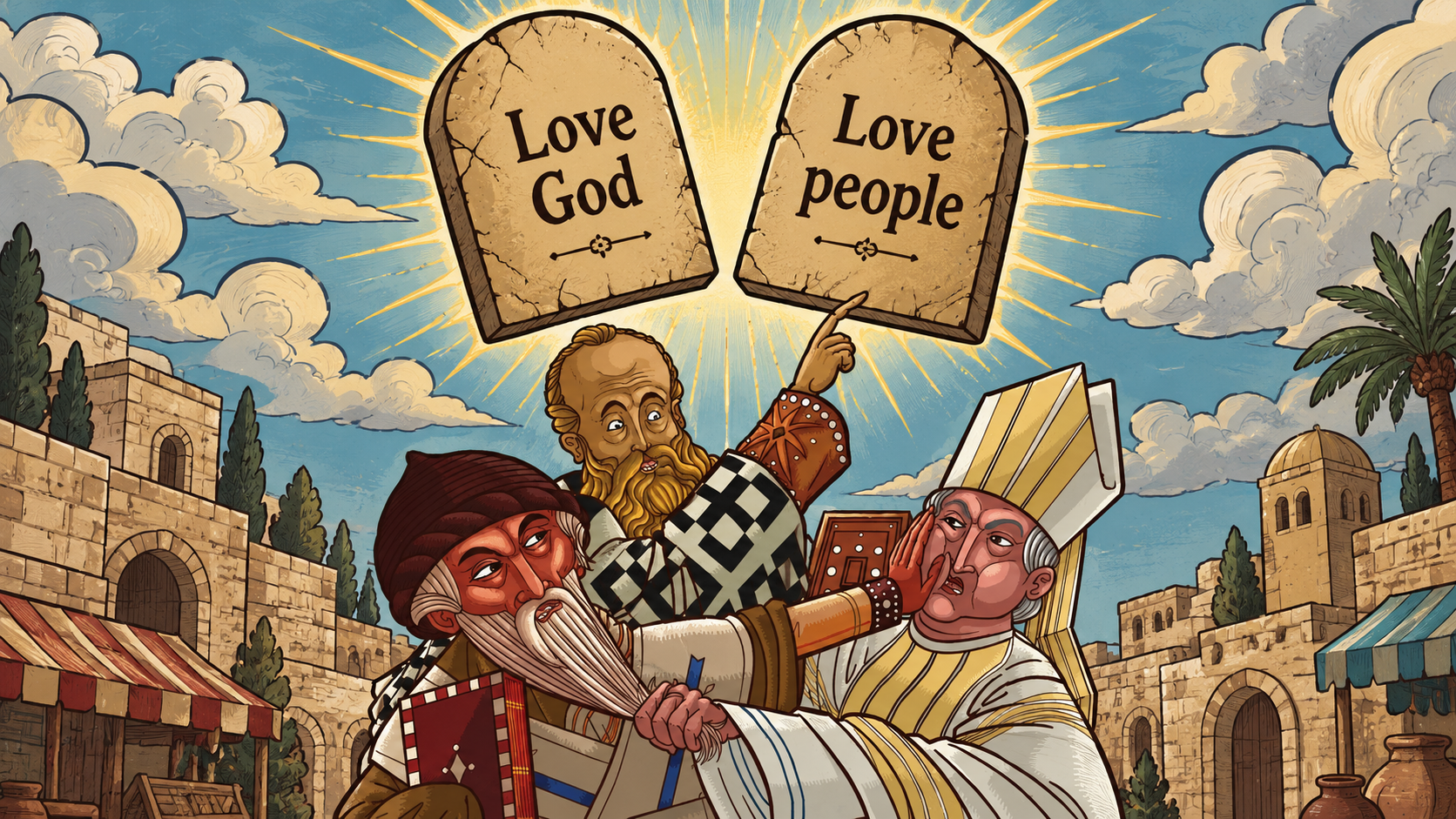
That's it. Love God. Love your neighbor. In our Lutheran tradition, the first three commandments deal with loving God, and the last seven deal with loving our neighbors. We call them the First and Second Tables of the Law. The commandments were given to us to explain what that love looks like: worship God, honor His name, hear His Word, honor your parents, protect your neighbor's life, marriage, possessions, and reputation.
Love God. Love your neighbor. Two simple rules. How hard can they be? Well, just because something is simple doesn't mean it's easy. Because we can't even make it through a normal day without breaking them.
I mean, we're pretty good at loving people who love us. Or loving people who agree with us. But when someone gets difficult, our commitment to loving our neighbor tends to be less impressive. We can be polite with someone at church and then spend the entire drive home complaining about what's wrong with them. We can sing about God's amazing grace on Sunday and then spend Monday afternoon hoping somebody who irritated us gets what’s coming to them. Someone disrespects us and all bets are off. Then we think about the Ten Commandments and congratulate ourselves because we haven't murdered anybody. Pretty low bar if you think about it.
This is why God's Law demands more than outward behavior. It demands our hearts. God doesn't just tell us not to steal our neighbor's fancy new truck, or car, or Cybertruck (if you’re me). He tells us not to covet it. Apparently, He's also concerned about the amount of time we spend staring at it, wondering why they get to drive something so cool while we have to save up the money to replace the serpentine belt on our minivan with the cracked windshield. He cares about our thoughts long before we actually do anything with them.
And when we look at God's commandments that way, we realize we're not quite as good as we've been telling ourselves.
Paul says in Romans 3:20,
"For by the law is the knowledge of sin."
God's Law works like a mirror. It shows us what's wrong with us. And the problem with a good mirror is it doesn't flatter us. It shows us what's actually going on, all the things we'd rather not see.
Lutherans have traditionally talked about three uses, or purposes, of God's Law. First, it acts as a curb, restraining evil and establishing order in a sinful world. Second, it's a mirror, exposing our sin and need for salvation. And third, it's a guide, showing God's redeemed people how He wants us to live. All three are important. But we have to understand what the Law can't do.
It can't save us.
It shows us our guilt, but it can't forgive us. It shows us what righteousness looks like, but it can't make us righteous. And no amount of trying harder can undo what we've already done. That's why Paul says in Galatians 3:24 that the Law serves as a guardian leading us to Christ. Our problem isn't that we need more complicated instructions. Our problem is that we need a Savior.
And that's why I love the way the Ten Words begin.
"I am the LORD your God, which has brought you out of the land of Egypt, out of the house of bondage."
God begins with the rescue. Before He tells His people what to do, He reminds them what He's already done. And that's not just an Old Testament idea. It's the same thing Paul tells us in Ephesians chapter 2.
"For by grace you have been saved through faith, and that not of yourselves; it is the gift of God, not of works, lest anyone should boast. For we are His workmanship, created in Christ Jesus for good works, which God prepared beforehand that we should walk in them."
Don't miss the order. God saves you by grace, through faith, apart from anything you've done. And then Paul says you've been created in Christ Jesus for good works. The good works don't come first. God's grace does. That's exactly what happened with Israel. God rescued His people before giving them the commandments. And through Jesus, He's done something even greater for you.
Jesus didn't come into the world to hand you another complicated set of instructions. He came to do what you couldn't do for yourself. The Law demands that you love God perfectly and love your neighbor as yourself perfectly. You’re not going to be able to do that but Jesus did both. Every commandment, every requirement, every expression of God's holy will—Jesus did it for you. Then He took the guilt of your law-breaking to the cross, suffered the punishment for your sins, and died in your place. And on the third day, He rose from the dead, defeating death and securing your salvation. Not by your obedience, but by His.
That's the difference between Law and Gospel. The Law tells you what God demands. The Gospel tells you what Jesus already accomplished. The Law exposes your guilt. The Gospel proclaims your forgiveness.
Salvation is a gift. How do you receive the gift? In your Baptism, God connected you to Christ's death and resurrection and made you His child. Through His Word, He announces your forgiveness and promises you an abundant life that will never end. In the Lord's Supper, He gives you His true body and blood for the forgiveness of your sins. You receive it all through faith.
You don't have to figure out how to rescue yourself. God has already done that through Jesus. And faith isn't one more good work you have to accomplish. It’s just trusting what Jesus has already done for you. That’s what faith is—trust in God’s goodness because of Jesus.
And your faithfulness to the commandments doesn't change that.
They don't turn salvation into a complicated theological board game where you have to collect enough good works, avoid the wrong cards, and somehow survive until the final judgment. Jesus has already promised your salvation.
So does that mean we can just ignore the commandments now? Of course not. Why would God save us just so we’d live like idiots? He doesn’t want us to be miserable. That would be like somebody paying off all our debts and us immediately maxing out the credit cards again. That's not freedom. That's finding a new way to be a slave.
God's commandments are good. They’re His will for our life. They’re the house rules. They show us how to live as His children. They're not a ladder we climb to get to heaven. They’re God's direction for the way we should walk on earth.
Love God. Love your neighbor. Pretty simple instructions for this game of life. Whether it’s how to treat our spouse, our children, our coworkers, or the person who just cut us off in traffic, it’s always the same question: What would loving my neighbor look like right now? It’s always going to mean being patient. It’s going to mean telling the truth. It’s going to mean forgiving people. Showing kindness and respect to people who are being disrespectful and mean to us. It’s almost always going to mean doing something difficult because it's the right thing to do.
When your spouse says something that bothers you, loving them might mean asking a few questions before deciding you know exactly what they meant—and assigning motives to them. When somebody interrupts your day with a problem you don't really want to deal with, loving them might mean putting down your phone, stopping what you're doing, looking at them, and giving them your full attention—actually listening.
And when God's Word shows you something you're doing wrong, don't argue with it. Don't start looking for exceptions or comparing yourself to somebody who's worse. Just admit it. That's the Law doing its job. Then remember what Jesus has already done for you, because His forgiveness is the answer to your sin. And then ask what it would look like to live differently as someone who's been forgiven.
So I still haven't played Credo. All those colorful cards and little bishops are still in the box, and they’ll probably stay there until somebody comes along who can explain how to play the game without making it sound like advanced theological calculus.
And maybe the game really isn't really that complicated. Maybe once somebody clarifies the basic idea, all those bizarre instructions will start making sense. Maybe it's actually a pretty simple game once you understand what you're supposed to be doing.
And that's what I've rediscovered about the Ten Commandments. They're not as complicated as we try to make them. Love God. Love your neighbor. That's the whole thing in a nutshell. He gave us the commandments to show what love is supposed to look like.
The problem isn't that we don’t understand what God wants. The problem is we don’t do it. That's why we need something more than instructions. We need Jesus.
It’s comforting to me that God knew all this before He ever gave Moses the tablets.
It’s comforting that the promise came first.
"I am the LORD your God, who brought you out of slavery."
God didn’t give us the Ten Commandments so we can try to save ourselves. He gave them to us to show our need for a Savior and to show us how to live—worship God, love people. AMEN.
Prayer
Heavenly Father, thank You for loving us enough to show us how to live. Thank You for Your commandments that teach us what is good, reveal our sin, and remind us how much we need Jesus. But most of all, thank You for rescuing us before we could ever do anything to deserve it. Thank You for sending Jesus to accomplish what we never could, forgiving our sins, and making us Your children. Help us to trust in Your promises and to love You and the people You place in our lives. And when we fail, remind us that our salvation rests not in what we do, but in what Jesus has already done for us. In His name we pray. Amen.